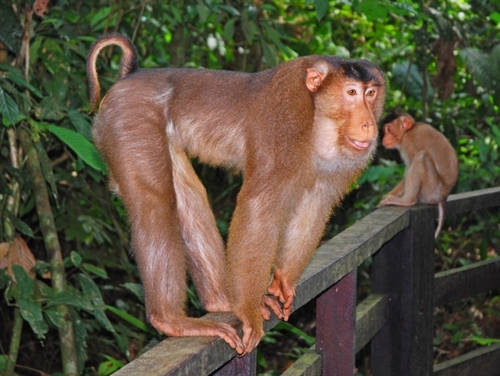
Southern Pig-tailed Macaque
Macaca nemestrina
With their iconic curled tails and expressive faces, Southern Pig-tailed Macaques are the charismatic heavyweights of the Southeast Asian forest floor. These highly intelligent primates offer a fascinating glimpse into complex social lives and adaptable survival strategies.
Quick Identification
Size
Body length 47-60 cm (18.5-23.6 in); weight 5-15 kg (11-33 lbs)
Colors
Golden-brown to olive-brown fur with a distinct dark brown or blackish patch on the crown of the head; underside is pale cream or white.
Key Features
- Short tail carried in an upward arch like a pig's
- Dark crown of hair contrasting with lighter face
- Long, dog-like muzzle with powerful jaws
- Stocky, muscular build with long limbs
When You’ll See Them
Geographic range
Where Does the Southern Pig-tailed Macaque Live?
The Southern Pig-tailed Macaque is a native resident of the Sundaland region in Southeast Asia. Its core range spans across the Malay Peninsula, starting from southern Thailand and extending through nearly all of Malaysia. It is also widely distributed across the major Indonesian islands of Sumatra and Borneo, as well as several smaller neighboring islands like Bangka and the Mentawai group. While they are lowland specialists, they are highly adaptable and are frequently spotted in fragmented forest patches near human developments.
Basemap © OpenStreetMap contributors
Behavior
Southern Pig-tailed Macaques are highly social primates that live in complex multi-male and multi-female groups, typically ranging from 15 to 40 individuals. Unlike many other macaque species that spend most of their time in the trees, these macaques are semi-terrestrial and spend a significant portion of their day foraging on the forest floor. They are remarkably intelligent and have been observed using sophisticated social cues and even basic tool-use in the wild.
In areas where their habitat overlaps with human settlements, they can become quite bold. They are famous in Southeast Asia as 'beruk,' where they have historically been trained to harvest coconuts. In a backyard or plantation setting, they are often seen as opportunistic foragers, moving through the undergrowth with a distinctive confident gait. Their social structure is matrilineal, meaning daughters stay with their mothers, creating strong family bonds that are evident in their frequent grooming sessions.
EverydayEarth exclusive
Camera Tips
When setting up a camera for Southern Pig-tailed Macaques, height and security are your two biggest considerations. Because these macaques are semi-terrestrial, you should place your camera about 0.5 to 1 meter (1.5 to 3 feet) off the ground to capture them as they travel along forest trails or plantation edges. However, they are incredibly curious and physically strong; always use a high-quality steel security box (bear box) and a heavy-duty python cable. They have been known to investigate, shake, and even bite cameras that aren't properly secured.
To attract them to a specific spot, fruit-based lures work best. Overripe bananas or jackfruit placed near the base of a large tree can keep a troop in front of the lens for several minutes. If you are in a suburban area or near a plantation, look for 'monkey highways'—consistent paths they take through the undergrowth or along fence lines. These macaques move in groups, so if you see one on your live feed, there are likely twenty more following behind it.
Set your camera to 'Burst Mode' or high-speed video. Pig-tailed Macaques are fast movers, and their social interactions—grooming, playing, or occasional squabbles—happen very quickly. A 3-shot burst ensures you get a clear look at the face or the distinctive 'pig tail' for identification. Because they are strictly diurnal, you can save battery by setting your camera to only trigger during daylight hours, though dawn and dusk often provide the most interesting social behaviors.
Similar Species
Species that look similar or are commonly confused with Southern Pig-tailed Macaque.
Long-tailed Macaque
Has a much longer tail (exceeding body length) and lacks the dark crown patch and arched tail carriage.
Northern Pig-tailed Macaque
Very similar but found further north; it has longer fur and the dark crown patch is less distinct and more 'V' shaped.
Stump-tailed Macaque
Has a much shorter, almost non-existent tail and a bright red face that darkens with age.
Frequently Asked Questions
Record Southern Pig-tailed Macaque at your habitat
Connect a camera to start building your own species record — AI identifies every visitor automatically.