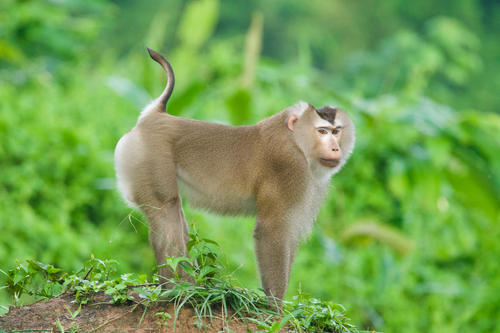
Northern Pig-tailed Macaque
Macaca leonina
A social strategist of the Southeast Asian canopy, the Northern Pig-tailed Macaque is easily recognized by its 'pigtail' and expressive, golden-brown face. These intelligent primates navigate a complex world of matriarchal hierarchies and forest foraging.
Quick Identification
Size
Body length 40–60 cm (16–24 in); weight 4.5–12 kg (10–26 lbs)
Colors
Golden-brown to olive-drab fur with pale undersides; dark brown or blackish crown patch; facial skin is pinkish-tan
Key Features
- Short tail carried in an upward arch or semi-erect
- Dark 'cap' of hair on the crown radiating from the center
- Prominent brow ridges with a dog-like muzzle
- Muscular, stocky build with long limbs
When You’ll See Them
Geographic range
Where Does the Northern Pig-tailed Macaque Live?
This resilient primate is native to the diverse landscapes of Southeast Asia, thriving in the broad belt of tropical forests north of the Isthmus of Kra. Its range extends across the mainland from the hills of Northeast India and Bangladesh, through Myanmar, Thailand, Laos, Cambodia, and Vietnam, reaching as far north as southern China. While they are forest specialists, they are increasingly found in fragmented habitats where jungle meets rural agriculture, though they lack introduced populations outside of their native Asian continent.
Basemap © OpenStreetMap contributors
Behavior
During the day, the troop moves through its home range in search of food, often following established arboreal and terrestrial pathways. They are known for their high intelligence and problem-solving abilities, which occasionally leads them into conflict with humans when they raid agricultural crops. At night, the entire troop retreats to the safety of high canopy branches to sleep, far from the reach of ground-based predators like leopards.
EverydayEarth exclusive
Camera Tips
To capture the best footage of Northern Pig-tailed Macaques, position your camera at a lower height than you would for other primates, approximately 3 to 4 feet (1 meter) off the ground. Because this species is semi-terrestrial, they frequently use forest trails and logging roads to travel. Aiming your camera at a slight downward angle toward a clearing or a known 'monkey highway'—a gap between two large fruiting trees—will significantly increase your chances of capturing the whole troop on the move.
Macaques are exceptionally curious and possess dexterous hands, which means they are likely to inspect, shake, or even try to dismantle your equipment if it is within reach. Always use a rugged, lockable security housing (bear box) and ensure the camera is strapped tightly to a thick, sturdy tree trunk. Avoid using shiny or brightly colored locks, as these can attract unwanted attention from juveniles looking for something to play with.
Since these monkeys move in large groups, a single-photo trigger often miss the most interesting social interactions. Set your camera to 'Hybrid Mode' or high-definition video with a 20-30 second duration. This allows you to record the fascinating hierarchy of the troop, from the dominant males leading the way to the mothers carrying infants at the rear. If you are monitoring a specific fruiting tree like a wild fig, place the camera at a distance to capture the wide-angle action of the monkeys descending to the lower branches.
Similar Species
Species that look similar or are commonly confused with Northern Pig-tailed Macaque.
Southern Pig-tailed Macaque
Found south of the Isthmus of Kra; females show much more pronounced skin swelling during estrus.
Rhesus Macaque
Lacks the arched 'pig' tail and dark crown cap; has a more reddish-orange tint to its hindquarters.
Stump-tailed Macaque
Has a much shorter, almost non-existent tail and a bright red face that darkens with age.
Frequently Asked Questions
Record Northern Pig-tailed Macaque at your habitat
Connect a camera to start building your own species record — AI identifies every visitor automatically.