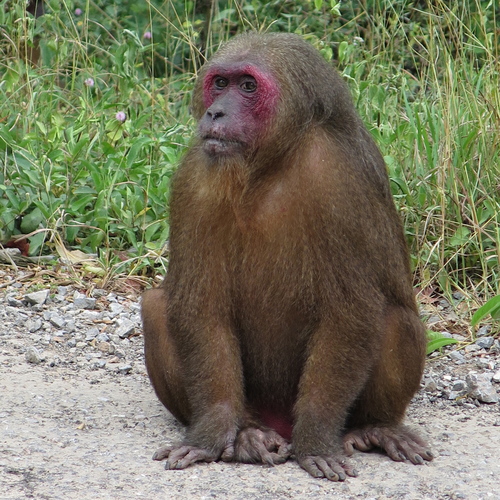
Stump-tailed Macaque
Macaca arctoides
Often called the 'Bear Macaque' for its stocky build and shaggy fur, the Stump-tailed Macaque is a fascinating, ground-dwelling primate of the Asian tropics. Distinguished by its nearly non-existent tail and striking red face, this social species offers a unique glimpse into the complex world of forest-floor dynamics.
Quick Identification
Size
Length: 48–65 cm (19–26 in); Weight: 9.7–18.1 kg (21–40 lbs) for males, 7.5–9.1 kg (17–20 lbs) for females.
Colors
Dark brown to blackish fur that thickens in colder climates; skin on the face is hairless and pinkish-red, often darkening to a deep mahogany or black with age and sun exposure.
Key Features
- Extremely short, hairless tail measuring only 3 to 10 cm
- Bright pink or reddish face that darkens as they mature
- Stocky, powerful build resembling a small bear
- Long, shaggy dark brown fur
- Large, expressive eyes with prominent brow ridges
When You’ll See Them
Geographic range
Where Does the Stump-tailed Macaque Live?
Native to the vast landscapes of South and Southeast Asia, the Stump-tailed Macaque primarily resides in the subtropical and tropical forests of northeastern India, southern China, and down through the Indochinese peninsula into Malaysia. In India, they are a flagship species for the biodiversity-rich states south of the Brahmaputra River, such as Assam and Meghalaya. This resilient primate thrives across diverse terrains, from lowland valleys to steep mountain slopes, making it a true specialist of the Asian forest interior.
Basemap © OpenStreetMap contributors
Behavior
The Stump-tailed Macaque is a highly social primate, typically found in troops of 20 to 50 individuals. Unlike many of its arboreal relatives, this species is primarily terrestrial, spending a significant portion of its day traveling on the forest floor. They move in a quadrupedal fashion and are known for their quiet, deliberate pace compared to the more frantic movements of Rhesus macaques. Within the troop, they maintain a strict linear hierarchy, though they are generally noted for being less aggressive and more egalitarian than other macaque species.
Their daily routine involves foraging during the morning and late afternoon, with a period of rest and social grooming during the midday heat. While they are wary of humans in areas where hunting occurs, they can become habituated to human presence near forest edges or agricultural lands. Interestingly, they possess a unique 'estrus' call and complex facial expressions to communicate social standing and intent within the group.
EverydayEarth exclusive
Camera Tips
Because Stump-tailed Macaques are predominantly terrestrial, your camera should be mounted much lower than for other primates. Aim for a height of about 1 to 2 feet (30-60 cm) off the ground, secured to a sturdy tree trunk. Angle the lens slightly upward to capture their full profile as they walk past. Since they travel in troops, use a wide-angle lens or place the camera in a clearing to ensure you capture more than just the leader of the group.
These macaques are highly sensitive to 'white-flash' cameras, which can spook the entire troop and cause them to avoid the area for weeks. Opt for a high-quality 'No-Glow' or 'Black Infrared' trail camera to keep the device invisible to their keen eyes. Setting your camera to 'Burst Mode' is essential; since they move in a line, a single photo will likely only catch the lead individual. A 3-5 photo burst with a short trigger delay will document the social structure of the troop.
While we don't recommend feeding wild primates, if you are monitoring them on private land near forest edges, placing your camera near natural attractants like fruiting fig trees or active water holes during the dry season will yield the best results. They are most active during the cooler parts of the day, so ensure your camera is set to its highest sensitivity during the morning and late afternoon. Be sure to use a protective security box, as macaques are notoriously curious and may try to 'inspect' or pull at any interesting object they find.
Similar Species
Species that look similar or are commonly confused with Stump-tailed Macaque.
Frequently Asked Questions
Record Stump-tailed Macaque at your habitat
Connect a camera to start building your own species record — AI identifies every visitor automatically.