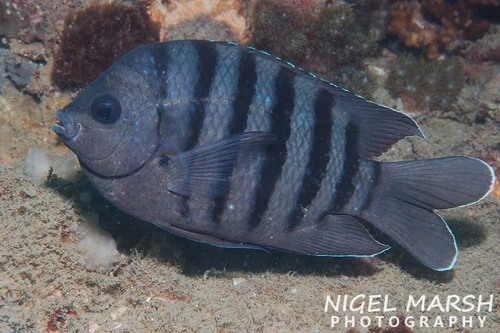
Bengal Sergeant
Abudefduf bengalensis
A striking resident of the Indo-Pacific's shallowest reefs, the Bengal Sergeant is a master of the surge zone. With its signature narrow stripes and fearless attitude, this damselfish is a favorite for underwater observers and backyard reef enthusiasts alike.
Quick Identification
Size
Typically 12–17 cm (4.7–6.7 inches) in length; weighs approximately 100–150 grams
Colors
Silvery-grey to pale greenish-yellow body with 6–7 distinct, narrow vertical dark brown or black bars
Key Features
- 6-7 narrow vertical dark bands along the sides
- Deep, laterally compressed oval body
- Small terminal mouth with brush-like teeth
- Forked tail with slightly rounded lobes
When You’ll See Them
Geographic range
Where Does the Bengal Sergeant Live?
Native to the tropical Indo-Pacific, the Bengal Sergeant occupies a wide stretch of coastal waters from the eastern Indian Ocean to the Western Pacific. Its core range includes the waters off Pakistan and India, extending through Southeast Asia to the Great Barrier Reef in Australia and as far north as southern Japan. Despite their prevalence in the Indian Ocean, they are uniquely absent from the Red Sea, preferring the nutrient-rich coastal fringes of the Asian and Australian continents.
Basemap © OpenStreetMap contributors
Behavior
The Bengal Sergeant is a highly active and territorial damselfish known for its bold personality. While they can be found in small, loose aggregations, adults are frequently observed patrolling their specific patch of reef or lagoon alone. They are diurnal, meaning they are most active during daylight hours when they forage for food and defend their chosen crevices from intruders.
During the spawning season, these fish exhibit complex social behaviors. Males become particularly aggressive, clearing a patch of rocky surface or coral to serve as a nest. They perform vibrant courtship displays to attract females and, once the eggs are laid, the male takes on the role of a dedicated guardian, vigorously fending off predators—including much larger fish and curious divers—until the larvae hatch.
EverydayEarth exclusive
Camera Tips
Capturing the Bengal Sergeant requires an underwater camera setup, such as an action camera or a specialized reef cam. Since these fish frequent very shallow water (1–6 meters), you can often achieve excellent results using natural sunlight. Position your camera on a weighted tripod or a flat coral rubble patch during the middle of the day, between 10 AM and 2 PM, when the sun is directly overhead to minimize surface reflection and maximize color penetration.
To attract a Bengal Sergeant to your lens, look for 'cleaning stations' or areas with high algae growth on rocky outcrops. While we don't recommend feeding wild fish, placing your camera near a prominent vertical structure or a jetty pylon will naturally put you in their patrol path. They are naturally curious and will often approach the camera housing to inspect their reflection, providing excellent opportunities for close-up shots.
For the best footage, use a high frame rate setting (at least 60fps) to compensate for the swaying of the water and the fish's quick, darting movements. If the water is slightly turbid, a red filter can help restore the natural colors lost to the water column, even at shallow depths. Ensure your camera is tethered to a buoy or a fixed point if you are leaving it unattended to prevent it from being moved by the surge or currents.
Similar Species
Species that look similar or are commonly confused with Bengal Sergeant.
Frequently Asked Questions
Record Bengal Sergeant at your habitat
Connect a camera to start building your own species record — AI identifies every visitor automatically.