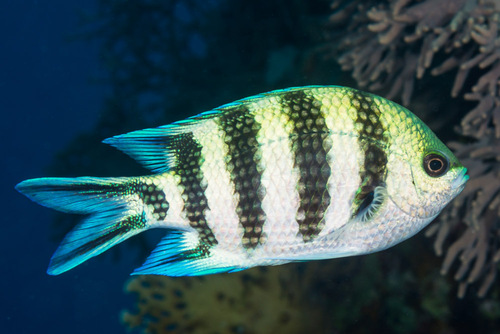
Scissortail Sergeant
Abudefduf sexfasciatus
Defined by its striking military stripes and elegant forked tail, the Scissortail Sergeant is a vibrant icon of the Indo-Pacific. These curious and social damselfish turn any shallow reef into a bustling underwater parade.
Quick Identification
Size
Grows up to 16 cm (6.3 inches) in length.
Colors
Silvery-white body with five to six vertical black bars; the deeply forked tail features a distinct black stripe on each lobe.
Key Features
- Deeply forked tail with horizontal black stripes on each lobe
- 5-6 vertical black 'sergeant' stripes on the body
- High-contrast silvery-white and black coloration
- Oval-shaped, laterally compressed body
When You’ll See Them
Geographic range
Where Does the Scissortail Sergeant Live?
The Scissortail Sergeant is widely distributed throughout the tropical waters of the Indo-Pacific region. Its native range stretches from the Red Sea and the eastern coast of Africa all the way across the Indian Ocean to the islands of the central Pacific, including French Polynesia. It is commonly sighted as far north as southern Japan and as far south as the northern coasts of Australia and the Great Barrier Reef.
Basemap © OpenStreetMap contributors
Behavior
The Scissortail Sergeant is a highly social and energetic species, often found in large, mid-water aggregations. They are frequently seen hovering above coral heads, particularly branching corals, which provide a quick refuge from predators. Unlike some of their more aggressive damselfish relatives, Scissortail Sergeants are relatively peaceful, though males become fiercely territorial when guarding egg patches on the rocky substrate.
These fish are diurnal and spend most of their daylight hours foraging in the water column. They are known for their curiosity and are often among the first fish to approach divers or underwater cameras. Their movement is characterized by quick, darting motions, using their 'scissortail' for rapid acceleration to catch drifting plankton or to escape a threat.
EverydayEarth exclusive
Camera Tips
Capturing the Scissortail Sergeant requires an underwater camera setup, such as a GoPro or a specialized reef-cam housing. Because these fish live in shallow water (often less than 5 metres), natural light is your best friend. Position your camera to face away from the sun to prevent glare and to highlight the silver sheen of their scales. If you are using a stationary 'backyard' pier camera, mounting it to a piling just below the low-tide mark will provide consistent action as these fish love structure.
To attract a school for the perfect shot, look for a 'cleaning station' or a large coral head. These fish are naturally curious about new objects in their environment. Avoid fast movements when placing the camera; once the camera is still, the school will usually return within minutes. Because they are mid-water swimmers, ensure your camera is angled slightly upward toward the surface to capture their silhouettes and the light filtering through the water.
Since Scissortail Sergeants are fast movers, use a high frame rate (at least 60 fps) to avoid motion blur. If your camera allows for it, a red filter can help restore the warm colors lost underwater, though in very shallow water (1-2 metres), the natural sunlight is usually sufficient for their black-and-white patterns. During the nesting season, look for males hovering close to a cleared patch of rock—they will stay in one spot longer, offering a great opportunity for a focused portrait.
Similar Species
Species that look similar or are commonly confused with Scissortail Sergeant.
Frequently Asked Questions
Record Scissortail Sergeant at your habitat
Connect a camera to start building your own species record — AI identifies every visitor automatically.