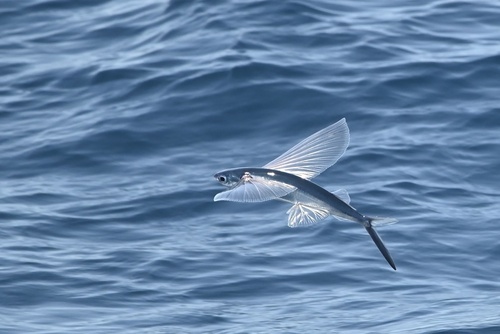
Bennett's Flyingfish
Cheilopogon pinnatibarbatus
Master of the waves and the air, Bennett's Flyingfish is a shimmering marvel of evolution. Watch as this oceanic acrobat launches itself from the deep to glide effortlessly across the surface.
Quick Identification
Size
Typically 30-40 cm (12-16 inches) in length, with some individuals reaching up to 50 cm (20 inches).
Colors
Deep indigo to dark blue on the back with a shimmering silvery-white belly; pectoral fins are dark with pale margins.
Key Features
- Oversized pectoral fins extending to the tail
- Asymmetrical forked tail with a longer lower lobe
- Streamlined, cylindrical body shape
- Prominent, high-set eyes for surface navigation
When You’ll See Them
Geographic range
Where Does the Bennett's Flyingfish Live?
Bennett's Flyingfish is a circumglobal species found throughout the tropical and subtropical regions of the Atlantic, Indian, and Pacific Oceans. In the Western Atlantic, they are common from the coast of the United States down to Brazil, while in the Pacific, they range from Japan to Australia and across to the shores of California and Mexico. They are particularly abundant in areas where warm currents meet continental shelves, making them a common sight for coastal residents in Florida, Hawaii, and the Caribbean.
Basemap © OpenStreetMap contributors
Behavior
Bennett's Flyingfish are famous for their remarkable ability to 'fly,' which is actually a sophisticated gliding technique used to escape predators like mahi-mahi and tuna. By beating their tails rapidly—up to 50 times per second—while still submerged, they generate enough thrust to break the surface at speeds exceeding 35 miles per hour. Once airborne, they spread their large pectoral fins like wings to glide over the waves, often covering distances of over 150 feet in a single flight.
Underwater, these fish are highly social and travel in loose schools near the ocean's surface. They are primarily nocturnal or crepuscular feeders, staying in deeper, cooler water during the heat of the day and rising to the surface as the sun sets. While they are not aggressive toward humans, they are often attracted to the lights of vessels at night, sometimes accidentally landing on the decks of boats or piers.
EverydayEarth exclusive
Camera Tips
Capturing Bennett's Flyingfish on a trail camera requires a coastal or boat-based setup, as these are oceanic dwellers. For those with a 'backyard' overlooking the sea, the most effective technique is to mount a waterproof camera on a pier or dock railing roughly 2 to 3 feet above the water line. Angle the camera horizontally across the water's surface rather than looking down; this perspective allows you to capture the full profile of the fish during its glide. Because they are incredibly fast, use the highest frame rate your camera supports (at least 60fps) to avoid motion blur.
To attract these fish to your camera's field of view at night, utilize a submerged or surface-level LED light. Bennett’s Flyingfish are naturally drawn to light sources in the dark, which attract the plankton they feed on and provide a visual lure for the fish themselves. A green or white light is often most effective. Ensure your camera's PIR (Passive Infrared) sensor is set to its highest sensitivity, or better yet, use a time-lapse mode with 1-second intervals if the trigger speed isn't fast enough to catch a fish mid-glide.
Placement is key relative to the wind and waves. These fish typically launch themselves into the wind to gain more lift, so if you are on a boat or a coastline with a prevailing breeze, aim your camera 'downwind' to catch them flying toward you. During the summer months when coastal waters are warmest, they are more likely to venture closer to shore. If using a camera on a moving boat, a hull-mounted waterproof camera looking outward from the wake can capture stunning footage of them using the boat's displacement to launch their glides.
Similar Species
Species that look similar or are commonly confused with Bennett's Flyingfish.
Frequently Asked Questions
Record Bennett's Flyingfish at your habitat
Connect a camera to start building your own species record — AI identifies every visitor automatically.