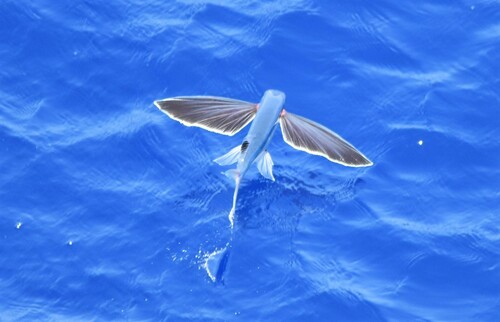
Margined Flyingfish
Cheilopogon cyanopterus
Witness the spectacular gliders of the deep blue sea. The Margined Flyingfish is an iridescent acrobat capable of soaring over waves to escape the world's fastest predators.
Quick Identification
Size
Typically 25–35 cm (10–14 inches) in length, reaching a maximum of 40 cm (16 inches); weight is usually under 0.5 kg (1 lb).
Colors
Iridescent dark blue or greenish-blue on the back with silver-white flanks and belly; the dorsal fin features a prominent dark or blackish spot or 'margin'.
Key Features
- Large wing-like pectoral fins reaching past the dorsal fin
- Prominent dark blotch on the upper dorsal fin
- Unevenly forked tail with a longer lower lobe
- Streamlined, cigar-shaped body designed for high-speed swimming
When You’ll See Them
Geographic range
Where Does the Margined Flyingfish Live?
The Margined Flyingfish is a cosmopolitan resident of the world's tropical and subtropical oceans. In the Western Atlantic, its range spans from the coastal waters of New Jersey down through the Caribbean and Gulf of Mexico to the shores of Brazil. It is equally at home in the Indo-Pacific, where it is frequently spotted from East Africa and the Red Sea across to Japan, Australia, and the various island chains of Oceania. While they prefer the deep blue of the open sea, they are often carried into temperate regions by warm-water currents like the Gulf Stream.
Basemap © OpenStreetMap contributors
Behavior
The Margined Flyingfish is a master of the 'aerial glide,' a specialized survival tactic used to escape underwater predators like tuna, mackerel, and billfish. By beating its tail rapidly—up to 70 times per second—while still submerged, it builds enough speed to break the surface. Once airborne, it spreads its large pectoral fins like wings, catching the wind to glide for distances of 50 to 200 meters, occasionally using the wave tops to 'taxi' and extend its flight.
These fish are highly social and often travel in large schools, which provides safety in numbers. They are primarily pelagic, meaning they spend their lives in the open ocean, but they are frequently observed by boaters and coastal residents when warm currents push them toward the shore. They are also known for their strong attraction to light at night, a behavior often utilized by traditional fishers and marine researchers.
EverydayEarth exclusive
Camera Tips
Capturing a Margined Flyingfish on camera requires a specialized approach since they are rarely 'backyard' visitors unless your backyard is a dock or a boat. For the best results, mount your AI-powered camera on a stable pier, jetty, or the gunwale of a boat. Angle the lens slightly above the water line to catch the fish mid-glide. Because these fish are incredibly fast, use a camera setting with a high shutter speed (at least 1/2000s) to freeze the motion of their translucent wings and the spray of water from their tail.
One of the most effective ways to 'bait' these fish for a camera is using light. At night, secure a waterproof LED light just below the surface or hang a bright lantern over the water. Margined Flyingfish are phototactic and will swim toward the glow, often leaping near the light source. This provides a predictable focal point for your camera's motion sensors. During the day, polarized filters are essential to cut through the ocean's surface glare, allowing the AI to better distinguish the fish from the surrounding waves.
If you are setting up a stationary trail cam near the coast, look for areas where the continental shelf drops off or where warm currents are known to brush against the shore. Seasonal peaks usually occur when water temperatures exceed 20°C (68°F). To capture the best colors, aim for 'Golden Hour' (shortly after sunrise or before sunset), when the low-angle light reflects off their iridescent blue scales, making them stand out sharply against the dark ocean water.
Similar Species
Species that look similar or are commonly confused with Margined Flyingfish.
Fourwing Flyingfish
Unlike the Margined Flyingfish, the Fourwing has large pelvic fins that act as a second set of 'wings,' and it lacks the dark spot on the dorsal fin.
Atlantic Flyingfish
Identified by its clear or light-colored wings; it lacks the specific dark pigmentation found on the dorsal fin of the Margined species.
Frequently Asked Questions
Record Margined Flyingfish at your habitat
Connect a camera to start building your own species record — AI identifies every visitor automatically.