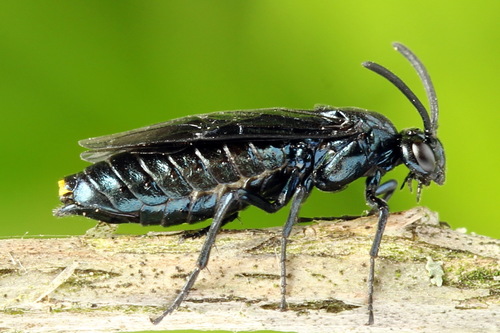
Berberis Sawfly
Arge berberidis
A striking metallic garden visitor known for its specialized diet and distinctive spotted larvae. The Berberis Sawfly is a fascinating example of how specific insects adapt to ornamental garden plants.
Quick Identification
Size
Adults: 7–10 mm (0.28–0.4 in) in length; Larvae: up to 20 mm (0.8 in) in length.
Colors
Adults are a uniform metallic blue-black; larvae are pale greyish-white or yellowish with numerous distinct black spots and a yellowish-orange head.
Key Features
- Metallic blue-black adult body
- Larvae with prominent black dots on a pale body
- Restricted to Berberis and Mahonia host plants
- Larvae adopt a distinctive 'S' shape when disturbed
When You’ll See Them
Geographic range
Where Does the Berberis Sawfly Live?
Originally native to the temperate regions of Central and Southern Europe and parts of Central Asia, the Berberis Sawfly has seen a rapid range expansion in recent decades. It was first recorded in the United Kingdom in the early 2000s and has since become a common garden inhabitant across most of Western Europe. Additionally, it has been introduced to parts of North America, following the distribution of ornamental barberry shrubs in residential and commercial landscaping.
Basemap © OpenStreetMap contributors
Behavior
The Berberis Sawfly is a specialized insect whose life cycle is intricately tied to plants in the Berberidaceae family. Unlike social wasps or bees, the adults are solitary and relatively poor fliers, often seen crawling or taking short flights between host plants on warm, still days. They do not possess a stinger and are completely harmless to humans. The females use a specialized, saw-like organ to cut into plant stems and deposit their eggs, which gives the 'sawfly' group its common name.
The most conspicuous stage of their behavior occurs when the larvae hatch. These larvae are gregarious feeders, meaning they often congregate in large groups to consume foliage. They are known for their 'skeletonizing' behavior, where they eat the soft tissue of leaves but leave the tougher veins intact. When threatened by a predator or a sudden vibration, the larvae reflexively arch their bodies into a defensive 'S' or 'U' shape, a visual deterrent designed to make them look less like a tasty meal.
EverydayEarth exclusive
Camera Tips
To successfully capture the Berberis Sawfly on camera, you must focus your efforts entirely on their host plants: Berberis (Barberry) or Mahonia. Because these insects are small, standard trail cameras may struggle with focus; using an AI-powered camera with macro capabilities or a dedicated close-up lens is highly recommended. Position your camera so it is aimed at the underside of fresh, green leaves or at stems showing signs of feeding damage, such as notched or skeletonized edges.
Lighting is your best friend when photographing the metallic adults. Aim to set up your gear where the plant receives dappled morning sunlight. This will make the iridescent blue-black body of the adult sawfly pop against the green foliage. For larvae, look for the 'S' shape defensive posture. If your camera has a time-lapse mode, it is the perfect tool for this species; a 4-hour time-lapse of a group of larvae can dramatically show how quickly they can strip a branch of its leaves.
Since motion sensors on many backyard cameras are calibrated for larger mammals, you might find that the sawfly doesn't always trigger a recording. To counter this, set your camera to a 'frequent capture' or 'periodic' mode during the peak afternoon hours when the sun is warmest. If you are specifically looking for adults, they are most often found on the uppermost leaves in direct sunlight, while larvae are usually found on the lower, more sheltered parts of the shrub. Ensure your camera is mounted securely, as even a slight breeze can move the branches out of the narrow focus field required for such small subjects.
Similar Species
Species that look similar or are commonly confused with Berberis Sawfly.
Frequently Asked Questions
Record Berberis Sawfly at your habitat
Connect a camera to start building your own species record — AI identifies every visitor automatically.