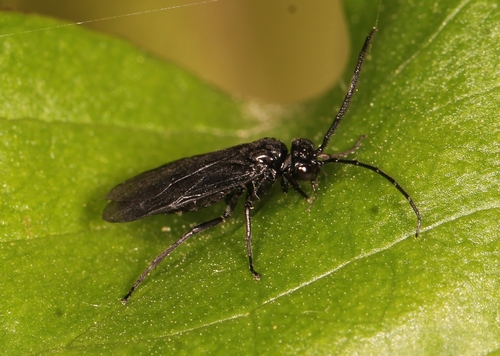
Solomon's-seal sawfly
Phymatocera aterrima
A specialist of the shaded garden, the Solomon's-seal sawfly is a master of disguise until its spotted larvae begin their late-spring feast. While gardeners may worry for their plants, these insects are a remarkable example of nature's host-specific cycles.
Quick Identification
Size
Adults 8-10 mm (0.3-0.4 in); Larvae up to 20 mm (0.8 in) in length
Colors
Adults are entirely soot-black with dark smoky wings. Larvae are pale greyish-white or bluish-grey with rows of distinct black spots.
Key Features
- Adults have an entirely black, chunky body and darkened wings
- Larvae have a pale grey body covered in small black dots
- Larvae are almost exclusively found on Solomon's-seal (Polygonatum) plants
- Adults lack the 'wasp-waist' and appear fly-like with serrated antennae.
When You’ll See Them
Geographic range
Where Does the Solomon's-seal sawfly Live?
Native to the Palearctic region, the Solomon's-seal sawfly is found throughout Europe, ranging from the United Kingdom and Scandinavia down to the Mediterranean, and extending eastwards across temperate Russia and parts of Asia. It is a common fixture in European temperate gardens, thriving wherever its specific host plant is cultivated or grows wild in damp, shaded woodland environments.
Basemap © OpenStreetMap contributors
Behavior
The Solomon's-seal sawfly is a specialist insect known primarily for the rapid defoliation its larvae cause to garden plants. The adults emerge in late spring, typically May and June, and are often seen flying clumsily around their host plants or resting on the undersides of leaves. Unlike social wasps, sawflies are solitary and do not sting; the 'saw' in their name refers to the female's specialized egg-laying organ (ovipositor), which she uses to cut slits into plant stems to deposit her eggs.
Once the eggs hatch, the larvae become the most conspicuous stage of the life cycle. They are gregarious feeders, often found in small groups stripping the leaves of Solomon's-seal down to the central veins. When threatened, the larvae exhibit a unique defensive behavior by curling their bodies into an 'S' shape or dropping instantly to the ground to hide in the leaf litter. By mid-summer, the larvae burrow into the soil to form a cocoon, where they remain until emerging as adults the following spring.
EverydayEarth exclusive
Camera Tips
To capture the Solomon's-seal sawfly on an AI camera, location is everything. You must position your camera directly facing a stand of Solomon's-seal (Polygonatum) plants. Because these insects are small, a standard trail camera may struggle with focus; use a camera with macro capabilities or a dedicated insect-monitoring lens. Mount the camera about 30-50 cm from the foliage, focusing on the leaf edges where larvae are most likely to feed.
The best time to set up your camera is in late May. Look for the first signs of 'pinholes' or notched edges on the leaves—this is the signal that the larvae have hatched. For the adult sawflies, target the stems on sunny mornings between 10 AM and 2 PM, as they are most active when the sun hits the leaves. Use a high-speed trigger or video mode to capture the adults, as their flight is somewhat erratic and slow compared to true flies.
If you are looking for the larvae, time-lapse mode is particularly effective. Setting the camera to take a photo every 5-10 minutes over the course of a week will produce a fascinating record of 'skeletonization,' where the plants appear to disappear before your eyes. Ensure your camera is positioned in a shaded area to avoid glare on the waxy leaves of the host plant, which can wash out the grey and black detail of the larvae.
Similar Species
Species that look similar or are commonly confused with Solomon's-seal sawfly.
Berberis Sawfly
Similar spotted larvae but feeds exclusively on Berberis and Mahonia plants rather than Solomon's-seal.
Turnip Sawfly
Adults have a bright orange body, unlike the soot-black body of the Solomon's-seal sawfly.
Rose Sawfly
Larvae are yellowish-green and feed on rose leaves; the Solomon's-seal sawfly is strictly limited to Polygonatum.
Frequently Asked Questions
Record Solomon's-seal sawfly at your habitat
Connect a camera to start building your own species record — AI identifies every visitor automatically.