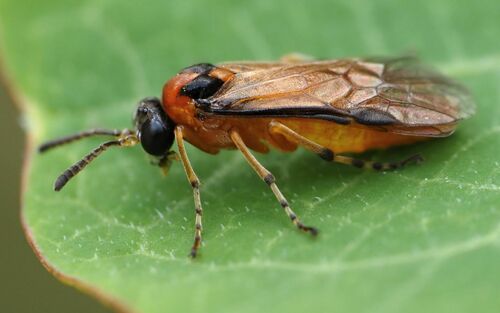
Turnip Sawfly
Athalia rosae
The Turnip Sawfly is a jewel-toned visitor to the summer garden, easily recognized by its glowing orange body and dark, velvety larvae. A fascinating example of garden biodiversity, it is a must-see for any backyard entomologist.
Quick Identification
Size
Adults: 7–8 mm (0.28–0.31 in) long; Larvae: 18–25 mm (0.7–1.0 in) long
Colors
Adults are vibrant orange with a black head and black dorsal patches on the thorax; larvae are dark velvety green to charcoal gray, appearing nearly black.
Key Features
- Bright orange body contrasting with a jet-black head
- Black 'stigma' mark on the leading edge of translucent wings
- Larvae have a caterpillar-like appearance but with 6-8 pairs of prolegs
- Slow, hovering flight pattern near ground level
When You’ll See Them
Geographic range
Where Does the Turnip Sawfly Live?
The Turnip Sawfly is native to the Palearctic region, maintaining a massive range that spans from the United Kingdom and across all of Europe into Northern Africa. Its territory stretches eastward through Russia and Central Asia, reaching as far as China and Japan. In these regions, it is a common inhabitant of both managed agricultural landscapes and domestic garden environments where its host plants are abundant.
Basemap © OpenStreetMap contributors
Behavior
The larvae are the most conspicuous stage of the life cycle, often found in large groups on the undersides of leaves. They are voracious eaters and can quickly skeletonize a plant, leaving only the tough veins behind. When disturbed, the larvae often adopt a distinctive 'S' shape or drop to the soil to hide in the debris. In a single season, they can produce up to three generations, meaning their presence in the garden can persist from early summer through the first frosts of autumn.
EverydayEarth exclusive
Camera Tips
Lighting is your best friend when filming this species. They are most active in direct sunlight, which provides the high shutter speeds needed to freeze their wing movement. Set your camera to a high-frame-rate video mode if you want to capture their unique 'sawing' egg-laying behavior. If you are using an AI-powered camera, ensure it is positioned no more than 12-18 inches from the foliage to trigger the motion sensors effectively.
For the best results, look for them during the peak of summer (July and August). If you notice small, dark, caterpillar-like creatures on your turnips, that is the time to set up your gear. Using a tripod for stability and a narrow aperture will help keep the entire insect in focus, allowing you to see the intricate black markings on the orange thorax that distinguish this species from other sawflies.
Similar Species
Species that look similar or are commonly confused with Turnip Sawfly.
Frequently Asked Questions
Record Turnip Sawfly at your habitat
Connect a camera to start building your own species record — AI identifies every visitor automatically.