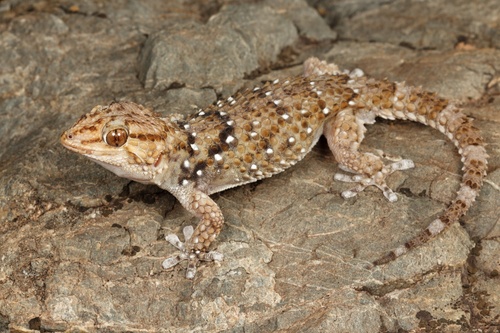
Bibron's Thick-toed Gecko
Chondrodactylus bibronii
The heavyweight champion of southern African geckos, Bibron's Thick-toed Gecko is a master of camouflage and vertical living. With its beaded skin and bold personality, it is one of the most fascinating reptiles to discover in a backyard safari.
Quick Identification
Size
Total length of 15 to 20 cm (6 to 8 inches); snout-to-vent length is typically 10 cm (4 inches).
Colors
Grey-brown or olive-brown base with dark, wavy crossbars and prominent white-tipped bumps (tubercles) across the back; cream or pale grey underbelly.
Key Features
- Robust, stocky build with a large, triangular head
- Raised, white-tipped tubercles giving a 'beaded' skin texture
- Broad, padded toes with expanded scales for climbing
- Horizontal pupils with scalloped edges designed for night vision
When You’ll See Them
Geographic range
Where Does the Bibron's Thick-toed Gecko Live?
This impressive gecko is native to the southern tip of the African continent, thriving across the diverse landscapes of southern Africa. Its core population is found throughout South Africa, Namibia, Botswana, and Eswatini, making it one of the region's most widespread and recognizable reptiles. While it is a southern African specialist, it has also been documented in southern Zimbabwe and Mozambique, where it favors rocky terrain and rural settlements.
Basemap © OpenStreetMap contributors
Behavior
Bibron's Thick-toed Gecko is a charismatic and surprisingly bold lizard. Unlike many of its more skittish relatives, this species is highly territorial and is known to stand its ground, often emitting a series of clicking or chirping vocalizations to warn off intruders. While primarily nocturnal, they are frequently seen emerging at dusk to stake out the best hunting spots, showing a high level of site fidelity.
In suburban environments, they have become remarkably adapted to human presence. They are 'commensal' animals, meaning they benefit from living near us by utilizing the walls of houses and outbuildings as artificial cliffs. They are social yet competitive, often living in small colonies where a dominant male defends a specific section of a wall or roof. They are not dangerous to humans and provide excellent pest control by consuming large quantities of nocturnal insects.
EverydayEarth exclusive
Camera Tips
Capturing Bibron's Thick-toed Gecko on a backyard camera requires a focus on vertical surfaces. Since these geckos are master climbers, mount your camera approximately 4 to 6 feet high, facing a brick wall, a stone pillar, or a large rock face. If you have an outdoor porch light that attracts moths, aim your camera at the surrounding wall area—this is their favorite hunting ground. Positioning the camera at a slight 45-degree angle to the wall can help capture the gecko's profile and the distinctive texture of its beaded skin.
Since they are strictly nocturnal, ensure your camera has a high-quality infrared (IR) flash or 'no-glow' LEDs. Standard white flashes can startle them and cause them to drop from the wall or retreat into a crevice. Set your camera to a 'Macro' or close-focus mode if available, as these geckos are relatively small subjects. A trigger speed of 0.5 seconds or faster is essential, as they can dart with surprising speed when pursuing a moth or avoiding a predator.
To naturally attract Bibron's Thick-toed Gecko, you don't need food bait; you need light. A low-wattage LED light placed within or just outside the camera's field of view will draw in the insects they crave. During the warmer months (September to April), they are most active. Look for them on warm nights following a rain, as insect activity peaks then, leading to spectacular 'feeding frenzies' on garden walls.
Similar Species
Species that look similar or are commonly confused with Bibron's Thick-toed Gecko.
Frequently Asked Questions
Record Bibron's Thick-toed Gecko at your habitat
Connect a camera to start building your own species record — AI identifies every visitor automatically.