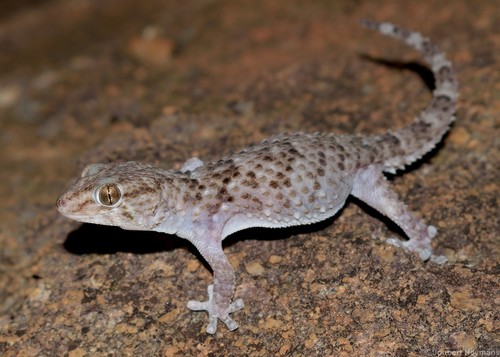
Turner's Thick-toed Gecko
Chondrodactylus turneri
A robust and charismatic resident of southern African gardens, Turner's Thick-toed Gecko is a master of the night. With its prehistoric-looking bumpy skin and large, watchful eyes, this gecko is a favorite for backyard observers looking to glimpse a miniature dragon in action.
Quick Identification
Size
10-18 cm (4-7 inches) total length; weight typically ranges from 15-35 grams.
Colors
Greyish-brown to dark sandy brown with irregular dark cross-bands; whitish or cream underside; distinctive pale tubercles (bumps) across the back.
Key Features
- Large triangular head with prominent eyes
- Heavily tuberculated skin giving it a 'bumpy' appearance
- Thick, fleshy toes lacking the expanded pads of common house geckos
- Robust, stocky body build
When You’ll See Them
Behavior
Turner's Thick-toed Gecko is a bold and territorial reptile that has adapted exceptionally well to human-modified landscapes. While naturally found in rocky outcrops and savanna environments, it is now a frequent visitor to suburban homes. Unlike many smaller geckos, Turner's is quite stocky and can be aggressive toward other geckos, often claiming the best hunting spots near outdoor lights for itself.
These geckos are primarily nocturnal, spending their days tucked away in deep rock crevices, under peeling bark, or in the cracks of man-made walls. At night, they emerge to hunt, often seen clinging to vertical surfaces. They are known for being quite vocal, producing a series of loud 'click-click-click' sounds to communicate with others or defend their territory during the breeding season. While they can be defensive if handled—often gaping their mouths or hissing—they are harmless to humans and are excellent at keeping insect populations in check.
EverydayEarth exclusive
Camera Tips
To get the best shots of Turner's Thick-toed Gecko, focus your camera on vertical 'hunting highways.' These geckos love to patrol the exterior walls of houses or stone garden walls. If you have an outdoor porch light that attracts insects, mount your camera 3-5 feet away from the light source, angled toward the wall. The gecko will likely appear in the periphery of the light to ambush moths and beetles. A side-on angle is better than a top-down view to capture the texture of their bumpy skin and their large, lidless eyes.
Because they are strictly nocturnal, your camera's Infrared (IR) performance is critical. Ensure your camera is set to its highest PIR sensitivity, as these geckos move with a 'stop-and-start' rhythm that can sometimes fail to trigger sluggish sensors. Use a camera with a short trigger speed (0.3s or less) to capture the moment they strike at prey, which happens in the blink of an eye. If your camera supports it, the 'hybrid mode' (taking a photo followed by a short video) is ideal for seeing both their intricate patterns and their unique stalking behavior.
If you don't have luck on house walls, look for natural 'dens.' Any deep crack in a rock face or a gap behind a wooden fence post is a potential home. Placing a camera near these entrances around dusk (6 PM - 8 PM) can capture them as they first emerge for the night. During the summer, you might even record social interactions or territorial disputes, which are accompanied by their characteristic clicking calls. Keep the lens clean, as geckos hunting near lights often attract dust and insects that can smudge your optics.
Similar Species
Species that look similar or are commonly confused with Turner's Thick-toed Gecko.
Frequently Asked Questions
Record Turner's Thick-toed Gecko at your habitat
Connect a camera to start building your own species record — AI identifies every visitor automatically.