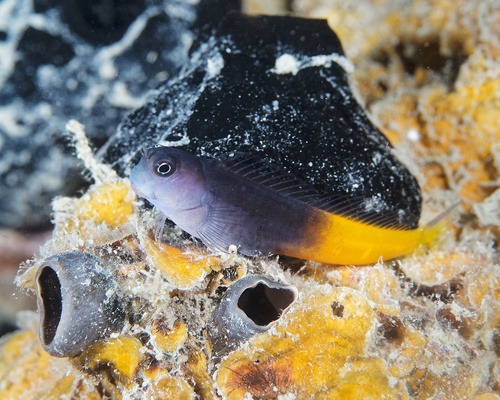
Bicolor Blenny
Ecsenius bicolor
A pint-sized powerhouse of personality, the Bicolor Blenny is a vibrant jewel of the Indo-Pacific reefs, known for its two-tone tuxedo and curious nature.
Quick Identification
Size
Grows up to 11 cm (4.3 inches) in length
Colors
Distinctive split color pattern with a dark purple or blue-grey front half and a bright orange or yellow posterior half
Key Features
- Bicolor pattern with dark front and orange rear
- Small branched 'cirri' or eyelashes above the eyes
- Continuous dorsal fin extending along the back
- Blunt, rounded head with large, expressive eyes
When You’ll See Them
Geographic range
Where Does the Bicolor Blenny Live?
The Bicolor Blenny is a wide-ranging resident of the tropical Indo-Pacific region. Its native waters stretch from the Maldives and the Chagos Islands in the west, across the diverse Coral Triangle including Indonesia and the Philippines, and as far east as the Phoenix and Line Islands. It is also commonly found along the northern coasts of Australia, including the Great Barrier Reef, where it thrives in shallow, sun-lit reef environments.
Basemap © OpenStreetMap contributors
Behavior
The Bicolor Blenny is a charming and territorial bottom-dweller known for its unique 'perching' behavior. Unlike many fish that swim continuously, this species spends much of its time sitting on coral branches or rocks, using its pelvic fins like tiny legs to prop itself up. They are famous for their 'bolt holes'—small crevices or empty shells where they retreat tail-first when threatened, leaving only their curious faces peeking out.
Socially, they are generally peaceful toward other species but can be quite feisty toward other blennies or fish with similar body shapes. They are highly active during the day, constantly hopping from one vantage point to another to graze on algae or keep watch over their territory. Their expressive facial movements and tendency to watch the world around them make them a favorite for underwater observers.
EverydayEarth exclusive
Camera Tips
Capturing the Bicolor Blenny on camera requires a focus on their favorite 'perches.' These fish are creatures of habit and will return to the same rock or coral head repeatedly. Position your underwater camera or action cam on a weighted tripod near a known algae patch or a small crevice where you have seen a blenny retreating. Because of their small size, a macro lens or a close-up focus setting is essential for a crisp shot.
Since they are sensitive to sudden movements, use a remote trigger or a motion-activated setup if possible. If you are filming in a home aquarium, place the camera outside the glass on a tripod to avoid reflections, and ensure the room is dark while the tank lights are on. Blennies are most active when the lighting is bright, as this mimics the high-noon sun of their natural reef habitats.
Wait for the 'peek-a-boo' moment. The best footage often comes from waiting for the blenny to emerge from its hole. They will usually poke their heads out first, look left and right, and then hop out fully. Setting your camera to a high frame rate (60fps or 120fps) will help you capture their quick, jerky swimming movements in smooth slow motion, revealing the delicate fluttering of their dorsal and pectoral fins.
Similar Species
Species that look similar or are commonly confused with Bicolor Blenny.
Frequently Asked Questions
Record Bicolor Blenny at your habitat
Connect a camera to start building your own species record — AI identifies every visitor automatically.