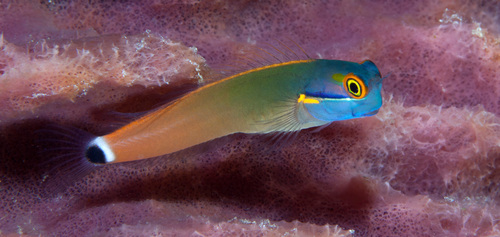
Tailspot Blenny
Ecsenius stigmatura
With its neon 'eyeliner' and curious personality, the Tailspot Blenny is the tiny, coppery star of the Western Pacific reefs.
Quick Identification
Size
Grows to a maximum length of 6 cm (2.4 inches); weight is negligible, typically under 15 grams.
Colors
Copper to orange-brown body with a distinctive blackish spot at the base of the tail. Features vibrant neon blue or hot pink horizontal stripes directly beneath the eyes.
Key Features
- Distinct black spot at the base of the tail
- Neon blue or pink 'eyeliner' markings
- Blunt, rounded head with large, expressive eyes
- Continuous dorsal fin and comb-like teeth
When You’ll See Them
Geographic range
Where Does the Tailspot Blenny Live?
The Tailspot Blenny is native to the tropical waters of the Western Pacific Ocean. Its primary range is centered within the Coral Triangle, spanning from the Philippines and Indonesia to the Solomon Islands and Palau. While it is most concentrated in these biodiversity hotspots, it can also be found in coastal reef systems as far north as Taiwan and as far south as the northern edges of the Great Barrier Reef.
Basemap © OpenStreetMap contributors
Behavior
The Tailspot Blenny is a charming and highly active reef fish known for its distinct personality. Unlike many fish that swim constantly in the water column, this species spends most of its time 'perching' on rocky outcroppings or coral heads using its pelvic fins. They are extremely territorial over their favorite hiding spots—typically small holes or crevices—and will often reverse into these spots tail-first so they can watch the world with only their heads protruding.
Socially, they are generally peaceful toward other reef inhabitants but can become feisty with members of their own species or other blennies that compete for the same food or territory. When they feel threatened or are engaging in courtship, the iridescent lines under their eyes can intensify in brightness, flashing a vivid pink to warn off intruders or attract a mate. They are diurnal creatures, retreating into the safety of the reef at night.
EverydayEarth exclusive
Camera Tips
Capturing high-quality footage of a Tailspot Blenny requires a specialized approach, as these are small, fast-moving marine animals. If you are using an underwater camera on a reef or in a 'backyard' reef aquarium, placement is everything. Look for a 'perch stone'—a flat-topped rock or coral head where the blenny frequently sits to scan its surroundings. Position your camera at eye level with this spot, ideally using a macro lens to capture the incredible detail of its iridescent eye markings.
For the best results, use a tripod or a weighted mount to keep the camera steady, as the jerky movements of the blenny can be difficult to track manually. Since they are herbivores, you can encourage them to stay in frame by positioning the camera near a patch of green filamentous algae. In aquarium settings, a high-definition 'clip-on' macro lens for a smartphone can yield professional results if you wait for the fish to approach the glass.
Lighting is the biggest challenge when photographing the Tailspot Blenny. To see the coppery body and the neon 'eyeliner,' you need bright, full-spectrum light. If you are diving, use a video light or strobe set at a 45-degree angle to avoid 'backscatter' (illuminating particles in the water). If you are filming in a tank, ensure your reef lights are at their peak intensity. Use a high frame rate (at least 60fps) because these fish dart between spots with lightning speed; higher frame rates allow you to slow down the footage to see their unique swimming mechanics.
Similar Species
Species that look similar or are commonly confused with Tailspot Blenny.
Frequently Asked Questions
Record Tailspot Blenny at your habitat
Connect a camera to start building your own species record — AI identifies every visitor automatically.