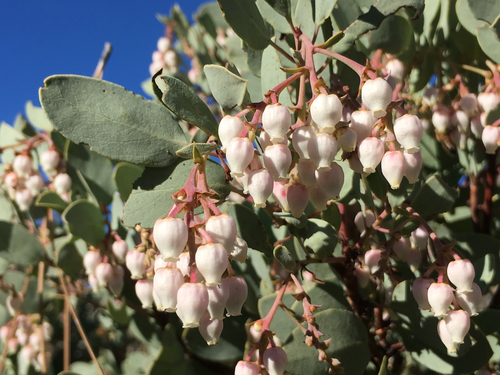
Big Berry Manzanita
Arctostaphylos glauca
The Big Berry Manzanita is the crown jewel of the California chaparral, recently honored as the official State Shrub. With its stunning mahogany bark and waxy blue leaves, it is a sculptural masterpiece that feeds an entire ecosystem.
Quick Identification
Size
A large shrub or small tree reaching 1–6 meters (3–20 feet) in height with a broad, spreading canopy.
Colors
Smooth, deep mahogany-red bark; pale waxy blue-green (glaucous) leaves; white to light pink flowers.
Key Features
- Smooth, chocolate-red bark that peels in thin strips
- Large, waxy, blue-green (glaucous) oval leaves
- Big, sticky, brownish-red berries (drupes) up to 2cm wide
- Clusters of white to pinkish urn-shaped flowers
When You’ll See Them
Geographic range
Where Does the Big Berry Manzanita Live?
The Big Berry Manzanita is a quintessential resident of the North American West, specifically native to the Mediterranean climate zones of California and northern Baja California. Its range extends from the North Coast Ranges and the Sierra Nevada foothills down through the Transverse and Peninsular Ranges into Mexico. It is most frequently encountered on dry, sun-drenched slopes and in rugged canyon lands where drainage is sharp and the sun is intense.
Basemap © OpenStreetMap contributors
Behavior
The Big Berry Manzanita is a cornerstone of the California chaparral, known for its striking architectural form and remarkable adaptation to fire. Unlike some manzanitas that regrow from a root crown after a fire, this species is an 'obligate seeder,' meaning the parent plant dies in a blaze and the population relies entirely on fire-activated seeds to sprout anew. Its growth is slow but sturdy, creating a dense, woody structure that provides essential cover for smaller wildlife.
Ecologically, the Big Berry Manzanita acts as a vital early-season resource. It blooms in late winter when few other plants are active, providing nectar for hummingbirds and emerging bees. As the seasons progress, its namesake large berries become a high-energy food source for various mammals and birds. For humans, it is a plant of deep cultural and aesthetic value, often admired for its sculptural, twisting branches and its 2025 designation as California's official State Shrub.
EverydayEarth exclusive
Camera Tips
To capture the beauty and the visitors of the Big Berry Manzanita, place your camera roughly 3–4 feet off the ground, angled slightly downward to focus on a cluster of flowers or low-hanging fruit. Because this shrub is a magnet for wildlife, positioning your camera near a well-established specimen can capture everything from Anna's Hummingbirds during the winter bloom to Coyotes and Gray Foxes snacking on fallen berries in the late summer.
For the best visual results, pay close attention to lighting. The mahogany bark of the manzanita is highly reflective and can look spectacular in the 'golden hour' of late afternoon. If you are using an AI-powered camera like those featured on EverydayEarth, set a wide-angle view to capture the architectural 'twisting' of the branches, which often frames visiting animals beautifully. Avoid placing the camera where it will be triggered by branches swaying in the heavy chaparral winds; instead, focus on a stable, thick trunk or a specific fruit cluster.
During the winter months (December through February), use a high-speed trigger setting to catch the rapid movement of pollinators. The white, urn-shaped flowers are small, so a 'macro' or close-focus placement (about 18–24 inches away) can reveal the intricate world of native bees and butterflies that rely on this plant when most other flora is dormant. In late summer, switch to a ground-level view to see the 'big berries' being harvested by ground-dwelling mammals.
Similar Species
Species that look similar or are commonly confused with Big Berry Manzanita.
Frequently Asked Questions
Record Big Berry Manzanita at your habitat
Connect a camera to start building your own species record — AI identifies every visitor automatically.