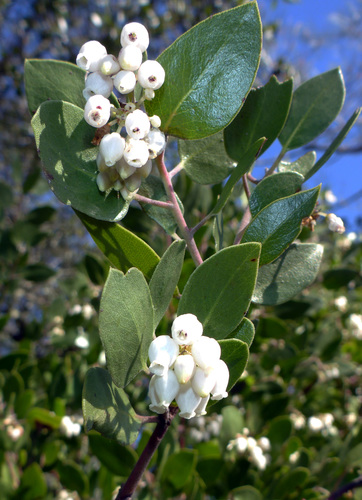
Common Manzanita
Arctostaphylos manzanita
The heartbeat of the California chaparral, the Common Manzanita stands out with its striking red bark and delicate, bell-shaped blooms that feed the forest.
Quick Identification
Size
Height: 2–8 meters (6.5–26 feet); Spread: 3–6 meters (10–20 feet)
Colors
Deep mahogany-red to purplish-brown bark; bright green to grey-green leathery leaves; pearly white to soft pink flowers.
Key Features
- Smooth, chocolate-red bark that peels in paper-thin layers
- Evergreen, stiff, oval leaves with a waxy texture
- Clusters of drooping, urn-shaped white or pink flowers
- Hard, round brownish-red berries resembling miniature apples
When You’ll See Them
Geographic range
Where Does the Common Manzanita Live?
The Common Manzanita is a quintessential California native, found almost exclusively within the borders of the Golden State. It dominates the landscape across the Sierra Nevada foothills and the North Coast Ranges, extending from the Oregon border down through central California. This species is perfectly adapted to the rugged, sun-drenched slopes of the American West, where it serves as a primary structural element of the scrubland.
Basemap © OpenStreetMap contributors
Behavior
These shrubs play a critical role in forest succession and fire ecology. Many manzanita species have seeds that remain dormant in the soil for decades, requiring the intense heat of a wildfire to trigger germination. Once established, they create a 'micro-canopy' that provides essential shade and shelter for smaller plants and ground-dwelling animals, while their leaf litter creates a natural mulch that helps retain precious soil moisture.
EverydayEarth exclusive
Camera Tips
To effectively capture the wildlife that depends on the Common Manzanita, position your camera at a height of 3 to 4 feet, aimed directly at a branch heavy with flowers or berries. During the late winter and early spring (February to April), these shrubs are one of the few nectar sources available. Set your camera to a high-speed video mode or a multi-shot burst to catch the rapid wingbeats of Anna’s Hummingbirds and the clumsy movements of early-emerging bumblebees as they visit the bell-shaped blossoms.
As the 'little apple' fruits ripen in the heat of the summer, lower your camera to roughly 18 inches off the ground. Place the camera along a visible trail leading into the manzanita thicket. This is the prime time to record the 'Manzanita Feast,' where Gray Foxes, Coyotes, and even Black Bears visit to forage for the nutrient-dense berries. The dark, smooth bark of the manzanita can create high-contrast scenes, so try to position your camera facing north or south to avoid the direct glare of the sun which can wash out your subjects.
Because the Common Manzanita is evergreen and maintains its structure year-round, it serves as an excellent 'stage' for capturing nesting behavior or birds seeking shelter from predators. If you have a trail camera with a macro lens or a close-focus setting, aim it at the twisting, mahogany-colored branches to document the various spiders and insects that live in the peeling bark. Avoid using heavy lures or baits directly on the plant, as the natural scent of the flowers and fruit is usually more than enough to attract the local fauna.
Similar Species
Species that look similar or are commonly confused with Common Manzanita.
Frequently Asked Questions
Record Common Manzanita at your habitat
Connect a camera to start building your own species record — AI identifies every visitor automatically.