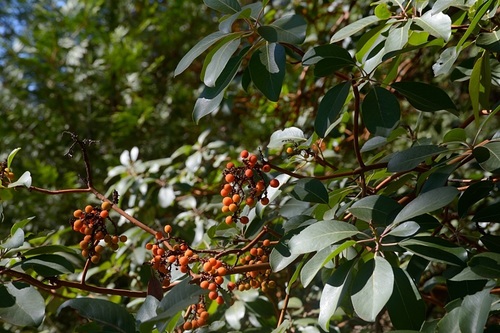
Pacific madrone
Arbutus menziesii
With its striking cinnamon-colored peeling bark and twisted limbs, the Pacific madrone is the crown jewel of West Coast forests. This resilient evergreen provides a year-round spectacle and serves as a vital winter buffet for local birds and mammals.
Quick Identification
Size
Typically 10-25 meters (33-82 feet) tall, occasionally reaching 30 meters; trunk diameter of 0.6-1.5 meters (2-5 feet).
Colors
Cinnamon-red to orange-brown peeling bark; chartreuse or smooth lime-green inner wood; dark waxy green upper leaves with grayish undersides; bright red to orange berries.
Key Features
- Paper-thin cinnamon bark that peels away in late summer
- Leathery, oval evergreen leaves with a glossy wax coating
- Large clusters of drooping, urn-shaped white flowers
- Twisted, contorted trunk and branch growth patterns
When You’ll See Them
Geographic range
Where Does the Pacific madrone Live?
The Pacific madrone is a signature species of the West Coast of North America. Its native range extends from the south-central coast of British Columbia, including Vancouver Island, down through the Puget Sound region of Washington and the Willamette Valley in Oregon, reaching as far south as the Palomar Mountains in Southern California. It is most frequently found within 50 miles of the coastline where the Pacific Ocean moderates the temperature.
Basemap © OpenStreetMap contributors
Behavior
The Pacific madrone is a slow-growing, long-lived evergreen hardwood that functions as a cornerstone of its ecosystem. Unlike most deciduous trees, it sheds its bark rather than all its leaves, revealing a smooth, cool-to-the-touch inner skin that shifts from lime green to deep copper as it ages. This peeling process is most dramatic in the heat of mid-to-late summer, creating a colorful litter of bark curls at the base of the trunk.
In the spring, the tree produces massive panicles of honey-scented flowers that are a primary nectar source for bees and hummingbirds. By autumn, these flowers develop into bumpy, pea-sized red berries. These fruits do not fall immediately but persist into winter, providing a critical high-energy food source for migratory birds and local mammals during the leanest months of the year.
EverydayEarth exclusive
Camera Tips
To capture the stunning aesthetics of the Pacific madrone, position your camera to take advantage of the 'golden hour'—the hour after sunrise or before sunset. The low-angle light makes the cinnamon-red bark appear to glow and highlights the texture of the peeling curls. If your camera has adjustable exposure settings, underexpose slightly to prevent the bright, smooth inner wood from washing out in direct sunlight.
For wildlife enthusiasts, the best time to point a camera at a madrone is during the autumn fruiting season (October through December). Mount your camera on a nearby branch or a secondary post facing a heavy cluster of berries. You are likely to capture Band-tailed Pigeons, Varied Thrushes, and American Robins gorging on the fruit. Because these birds are often fast-moving, use a 'burst mode' or high-speed video setting to catch the action.
Don't forget the base of the tree! Many mammals, including Mule Deer and Gray Foxes, visit madrones to scavenge fallen berries or utilize the contorted low-hanging limbs as rubbing posts or lookouts. Placing a camera 2-3 feet off the ground, angled toward the trunk base, can reveal a hidden world of nocturnal visitors attracted to the tree's bounty. Avoid using heavy straps that might damage the delicate, paper-thin bark; instead, use a mounting bracket or a tripod whenever possible.
Similar Species
Species that look similar or are commonly confused with Pacific madrone.
Frequently Asked Questions
Record Pacific madrone at your habitat
Connect a camera to start building your own species record — AI identifies every visitor automatically.