strawberry tree
Arbutus unedo
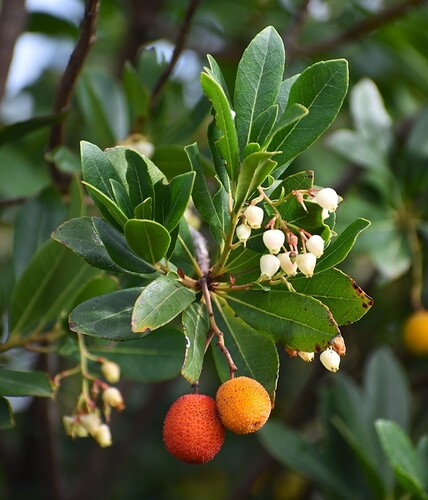
A Mediterranean treasure that brings the garden to life in winter, the strawberry tree is famous for its festive red berries and peeling cinnamon-colored bark. It is one of the few plants that provides a vital bridge of food for birds and pollinators when the rest of the world is dormant.
Quick Identification
Size
Typically 5–10 metres (16–33 feet) tall and wide, though often maintained as a large shrub in garden settings.
Colors
Dark leathery green foliage; reddish-brown peeling bark; waxy white to pale pink flowers; berries that transition from yellow to bright orange and deep scarlet red.
Key Features
- Rough, bumpy red fruit resembling strawberries
- Bell-shaped white or pink flower clusters
- Peeling, flaky reddish-brown bark on mature limbs
- Leathery, serrated evergreen leaves with a glossy finish
When You’ll See Them
Geographic range
Where Does the strawberry tree Live?
The strawberry tree is native to the Mediterranean Basin and the fringes of Western Europe. Its core range spans across Mediterranean countries including Spain, Portugal, Italy, Greece, and Turkey, extending south into North Africa. Interestingly, it also features a notable disjunct population in southwestern Ireland, where it is a famous component of the Killarney woods. While native to these regions, it has been introduced as a popular ornamental tree in temperate climates worldwide, particularly in the western United States and Australia.
Basemap © OpenStreetMap contributors
Behavior
The strawberry tree is a hardy, slow-growing evergreen that holds a unique place in the garden ecosystem. Unlike most plants, it produces flowers and ripe fruit simultaneously during the autumn and winter months. This 'double-duty' cycle makes it an invaluable resource for wildlife during the leanest months of the year, providing both nectar for late-season pollinators and high-energy fruit for birds and mammals.
In a backyard setting, the tree is generally well-behaved and non-invasive. It develops a gnarled, characterful structure as it ages, often growing multiple stems. While humans often find the fruit bland or mealy, it is a magnet for garden activity. You will frequently observe a 'vertical hierarchy' of feeders, with birds occupying the canopy and small mammals scavenging fallen fruit from the ground.
EverydayEarth exclusive
Camera Tips
To capture the best wildlife action on your strawberry tree, place your camera at a mid-level height (about 4–6 feet) facing a cluster of ripening fruit. Because the tree fruits in late autumn and winter, it becomes a focal point for birds like thrushes, blackbirds, and robins. Use a camera with a fast trigger speed, as birds moving through the inner branches can be quick. If your camera has a macro or close-focus mode, use it to capture the intricate bell-shaped flowers which attract late-season bees and butterflies.
Don't ignore the base of the tree! Many mammals, including foxes, badgers, and wood mice, are drawn to the fermented, fallen fruit on the ground. Position a second 'scout' camera about 12 inches off the ground, angled slightly downward toward a patch of dropped berries. This is a prime spot for capturing nocturnal activity that you would otherwise miss during the day.
Lighting can be tricky under the dense evergreen canopy. If possible, position your camera facing north or south to avoid direct lens flare from the low winter sun. Since the strawberry tree provides great cover, wildlife often feels safer and lingers longer than they would at an open bird feeder. Set your camera to take short video clips (10–15 seconds) rather than just stills to capture the social interactions between birds competing for the best berries.
Similar Species
Species that look similar or are commonly confused with strawberry tree.
Frequently Asked Questions
Record strawberry tree at your habitat
Connect a camera to start building your own species record — AI identifies every visitor automatically.