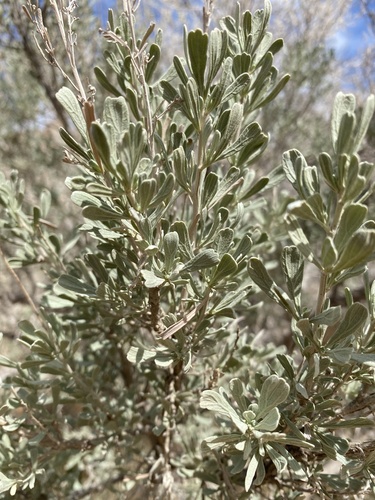
Big Sagebrush
Artemisia tridentata
The aromatic soul of the American West, Big Sagebrush is more than just a plant—it's a critical sanctuary for high-desert wildlife.
Quick Identification
Size
Height ranges from 0.5 to 3 meters (1.5 to 10 feet), with a canopy spread of 1 to 2 meters (3 to 6 feet).
Colors
Silvery-gray to pale green foliage; mature trunks have grayish-brown, shredding bark.
Key Features
- Wedge-shaped leaves with three distinct lobes or 'teeth' at the tip
- Strongly aromatic, pungent camphor-like scent when crushed
- Fine, silvery hairs on leaves that give a velvet appearance
- Gnarled, woody trunk with peeling, fibrous bark
When You’ll See Them
Geographic range
Where Does the Big Sagebrush Live?
Big Sagebrush is native to the vast interior of western North America. It is the dominant plant across the Great Basin and extends northward into the southern reaches of British Columbia and Alberta, Canada. In the United States, its range stretches from the eastern slopes of the Sierra Nevada and Cascade ranges to the western edge of the Great Plains, reaching as far south as Baja California, Mexico.
Basemap © OpenStreetMap contributors
Behavior
Big Sagebrush is the iconic landscape-defining plant of the American West. While it may appear static, it is a highly evolved survivor that uses a deep taproot (reaching up to 4 meters) to access water during intense droughts. It plays a foundational role in its ecosystem, providing both shelter and high-protein winter forage for a vast array of wildlife, including the sage-grouse and pygmy rabbit.
Interestingly, Big Sagebrush is known for its chemical communication. When a branch is damaged by insects, the plant releases volatile organic compounds that signal neighboring branches—and even neighboring plants—to boost their chemical defenses. While it is sensitive to fire and does not resprout from its roots, it produces thousands of tiny seeds that can quickly reclaim disturbed soil under the right conditions.
EverydayEarth exclusive
Camera Tips
Big Sagebrush is an excellent focal point for a backyard or trail camera because it acts as a 'wildlife hub.' To capture the animals that rely on it, place your camera about 12 to 18 inches off the ground, angled slightly upward. This positioning is perfect for spotting pygmy rabbits, ground squirrels, and various lizards that seek shade under the sagebrush canopy.
If you are looking to capture larger mammals like Mule Deer or Pronghorn, position your camera 3 to 5 feet away from a large sagebrush stand. During the winter, these animals frequent sagebrush for forage, making it the best time to see browsing behavior. Ensure the camera is not facing directly into the sun, as the silvery foliage of the Big Sagebrush can cause significant glare and overexposure in bright daylight.
For those interested in time-lapse photography, Big Sagebrush is a rewarding subject from late August to October. This is when the plant produces its yellow flower clusters. A time-lapse of the flowering process against a desert sunset provides stunning visuals. Because sagebrush is often located in windy, open areas, use a sturdy mount or a post-stake rather than a flexible strap to prevent the camera from vibrating and triggering false motion alerts.
Lastly, consider the 'scent factor.' You don't need bait to attract wildlife to a healthy sagebrush plant; the plant itself is the attractant. However, placing your camera near a 'nurse plant'—a large sagebrush protecting smaller seedlings—often reveals high levels of biodiversity, as the microclimate under the shrub is significantly cooler and more humid than the surrounding open ground.
Similar Species
Species that look similar or are commonly confused with Big Sagebrush.
Low Sagebrush
Much shorter (rarely over 12 inches) and prefers rocky, shallow soils where Big Sagebrush cannot grow.
Silver Sagebrush
Has long, slender leaves that usually lack the three-toothed tips and are a brighter, more metallic silver.
Rubber Rabbitbrush
Features thin, linear leaves and vibrant yellow flowers in the fall, lacks the three-toothed leaf tip of sagebrush.
Frequently Asked Questions
Record Big Sagebrush at your habitat
Connect a camera to start building your own species record — AI identifies every visitor automatically.