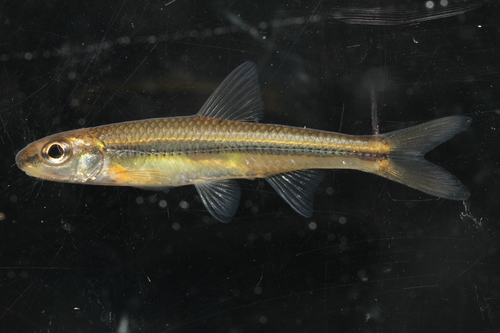
Bigeye Chub
Hybopsis amblops
A sparkling jewel of clean American streams, the Bigeye Chub is defined by its massive, soulful eyes and its preference for crystal-clear water. This small minnow is the ultimate 'canary in the coal mine' for river health.
Quick Identification
Size
2 to 3.2 inches (5 to 8 cm); weight typically less than 0.2 ounces (5 grams)
Colors
Olive to silvery-yellow back with silvery sides and a white belly; a prominent dark lateral stripe runs from the snout through the eye to the tail base
Key Features
- Exceptionally large eyes relative to head size
- Continuous dark horizontal stripe from snout to tail
- Small, inconspicuous barbels at the corners of the mouth
- Slender, streamlined body with a slightly translucent appearance
When You’ll See Them
Geographic range
Where Does the Bigeye Chub Live?
Native to the North American continent, the Bigeye Chub is primarily concentrated in the eastern and central United States. Its core populations are found throughout the Ohio River basin and the Tennessee River system, extending westward into the Ozark Highlands of Missouri and Arkansas. Because it requires pristine, silt-free water, its distribution within these regions is often patchy, highlighting the cleanest watersheds in the Mississippi River drainage.
Basemap © OpenStreetMap contributors
Behavior
The Bigeye Chub is a peaceful, schooling minnow that serves as a vital indicator of ecosystem health. Unlike many hardier minnows that can tolerate murky conditions, these fish are highly sensitive to siltation. They spend their days hovering near the substrate in clear, moving water, using their oversized eyes to visually scan for tiny organisms drifting in the current.
Social by nature, they are often found in small groups, sometimes shoaling alongside other shiner species. They are not known to be territorial or aggressive; instead, they rely on their speed and school cohesion to avoid predators like bass or kingfishers. Their behavior is dictated largely by water clarity; if a stream becomes too turbid, these fish will often vacate the area or cease feeding until conditions improve.
EverydayEarth exclusive
Camera Tips
To capture the Bigeye Chub, you will need a waterproof action camera or a specialized underwater trail camera. Position the camera in a shallow 'run'—a section of the stream with visible current and a gravel bottom. Set the camera just a few inches above the substrate, facing slightly upstream or across the current at a 45-degree angle. This placement mimics the natural perspective of a fish and captures the characteristic silver flash of their scales as they dart for food.
Because these fish are visual hunters, lighting is everything. Place your camera in a spot where sunlight penetrates the canopy and hits the stream bed; the extra light will help the camera's sensor resolve the fine details of their large eyes and lateral stripes. If the water is deep, ensure your camera is weighted properly so the current doesn't shift your frame. Avoid using bright artificial lights at night, as these fish are primarily diurnal and will likely be inactive or hiding in crevices during dark hours.
A unique trick for attracting Bigeye Chub is to 'chum' the water using natural methods. Gently stir up a small patch of gravel about three feet upstream of your camera. This releases microscopic larvae and 'drifters' into the water column, which will often draw a school of chubs directly in front of your lens to investigate the sudden bounty. Set your camera to a high frame rate (at least 60fps) to capture their lightning-fast feeding strikes, which are often too quick for the human eye to see in real-time.
Similar Species
Species that look similar or are commonly confused with Bigeye Chub.
Frequently Asked Questions
Record Bigeye Chub at your habitat
Connect a camera to start building your own species record — AI identifies every visitor automatically.