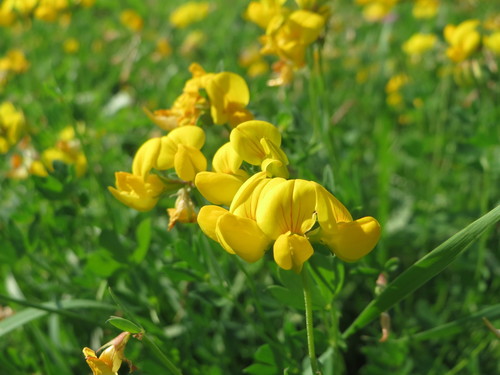
bird's-foot trefoil
Lotus corniculatus
Often called 'eggs and bacon' for its red-streaked yellow petals, this resilient wildflower is a vital oasis for butterflies and bees. Its unique seed pods, shaped like a bird's foot, make it one of the easiest and most rewarding plants to identify in your backyard.
Quick Identification
Size
Stems typically reach 5–30 cm (2–12 inches) in height, sprawling outward to a width of 60 cm (24 inches).
Colors
Bright yellow flowers often streaked with red or orange; clover-like green foliage.
Key Features
- Clusters of 2-7 yellow pea-like flowers
- Seed pods arranged in a pattern resembling a bird's foot
- Leaves have five leaflets, with three at the tip and two at the base
- Low-growing, sprawling or decumbent growth habit
When You’ll See Them
Geographic range
Where Does the bird's-foot trefoil Live?
Native to the temperate stretches of Eurasia and North Africa, bird's-foot trefoil has become a globetrotting survivor. It is now a common sight throughout the United Kingdom and much of Europe, while also flourishing as a naturalized species across the United States, southern Canada, and parts of Australia. Its ability to thrive in poor soils has allowed it to blanket vast landscapes, from Mediterranean cliffsides to the sprawling roadsides of the American Midwest.
Basemap © OpenStreetMap contributors
Behavior
Bird's-foot trefoil is a hardy perennial plant that exhibits a fascinating growth habit designed for survival in high-traffic areas. While it appears to be a passive member of the meadow, it is highly interactive with its environment. It features a deep taproot and a symbiotic relationship with soil bacteria to fix nitrogen, effectively fertilizing the soil as it grows. At night or during heavy rain, the plant exhibits nyctinasty, where its petals and leaves close slightly to protect its delicate reproductive parts.
In the backyard ecosystem, this plant acts as a social cornerstone. It is a major nectar source for long-tongued bees and serves as the primary food plant for the caterpillars of the Common Blue butterfly. Its sprawling stems create a dense mat that provides cover for ground-dwelling insects and small invertebrates, making it a hotspot of activity for any ground-level camera setup.
EverydayEarth exclusive
Camera Tips
To capture the life surrounding bird’s-foot trefoil, position your AI camera at an ultra-low angle, roughly 10–15 centimeters (4–6 inches) from the ground. Because this plant is a low-growing creeper, a standard tripod is usually too tall; instead, use a ground spike or a weighted beanbag to stabilize the camera. Focus on a vibrant cluster of yellow flowers to act as a natural 'stage' for the pollinators that will inevitably visit. If your camera has a macro mode or a close-focus setting, this is the perfect species to test it on, as the intricate red 'veins' on the yellow petals are a striking visual detail.
For a unique perspective, set your camera to time-lapse mode during the peak blooming months of June and July. Capturing one frame every 15 to 30 minutes over a week will reveal the plant's sprawling growth and the way the flowers follow the sun. This also allows you to see the nyctinastic movement as the blooms close up tight when the sun goes down. Ensure the area is well-lit, as the bright yellow petals can lose their detail in heavy shade, but be wary of the midday sun which can overexpose the vibrant colors—early morning 'golden hour' light is best.
If you are looking to record butterfly activity, especially the Common Blue, place your camera near a patch of bird's-foot trefoil on a calm, sunny day with temperatures above 15°C (60°F). Use a high-sensitivity motion trigger or a short-interval photo burst. The plant's nectar is highly attractive to bees and butterflies, ensuring frequent 'visitors' to your frame. In late summer, keep the camera in place to document the transition from flowers to the namesake 'bird's foot' seed pods, which are dark and claw-like, providing a completely different aesthetic for your wildlife collection.
Similar Species
Species that look similar or are commonly confused with bird's-foot trefoil.
Frequently Asked Questions
Record bird's-foot trefoil at your habitat
Connect a camera to start building your own species record — AI identifies every visitor automatically.