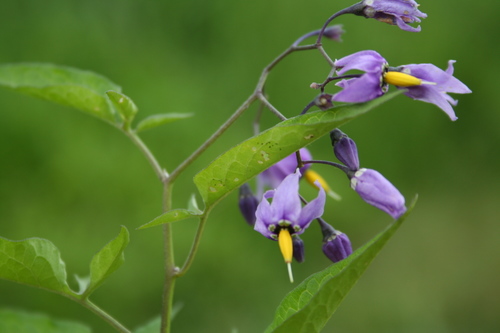
bittersweet nightshade
Solanum dulcamara
A striking climber known for its star-shaped purple blooms and jewel-like red berries, Bittersweet Nightshade adds a splash of dramatic color to backyard edges.
Quick Identification
Size
A scrambling vine reaching 1 to 4 metres (3 to 13 feet) in length, often forming dense thickets.
Colors
Deep green foliage; vibrant purple flowers with prominent yellow centers; berries that transition from green to bright orange and finally scarlet red.
Key Features
- Star-shaped purple flowers with swept-back petals and a yellow cone
- Heart-shaped leaves often with two smaller lobes at the base
- Clusters of egg-shaped, glossy red berries
- Woody base with herbaceous climbing stems
When You’ll See Them
Geographic range
Where Does the bittersweet nightshade Live?
Native across the temperate regions of Europe and Asia, Bittersweet Nightshade has become widely naturalized across much of North America. It is found throughout the United States and southern Canada, thriving particularly in the Northeast and Pacific Northwest. It is an adaptable species that has successfully moved from its original Eurasian wetlands into suburban landscapes globally.
Basemap © OpenStreetMap contributors
Behavior
Bittersweet Nightshade is a resilient, perennial vine that uses other plants or structures for support, though it can also grow as a low-lying groundcover. It is famous for its 'buzz pollination' mechanism, where bumblebees vibrate their wing muscles at a specific frequency to release pollen from the flower's yellow anthers. Despite its delicate beauty, the plant is moderately toxic to humans and livestock due to the presence of solanine.
In the backyard ecosystem, this plant acts as a bridge between seasons. Its long-lasting berries provide a vital food source for many bird species during the late summer and autumn when other food sources may be scarce. While it can be aggressive in garden settings, it serves as an important host and nectar source for specialized insects.
EverydayEarth exclusive
Camera Tips
To capture the stunning transformation of Bittersweet Nightshade, set your camera to a time-lapse mode during the late spring. Aim your lens at a cluster of buds; within a few days, you'll record the dramatic 'sweeping back' of the purple petals. Because the stems are thin, ensure your camera is mounted on a stable post rather than a swaying branch to avoid motion blur.
If you are looking to capture wildlife interactions, focus your camera on the ripening red berries during the early morning hours in late August. This is the peak time for foraging birds. Use a high-speed trigger setting or a short-interval photo burst, as birds like cedar waxwings and thrushes move quickly when plucking berries from the vine.
For the best lighting, position your camera facing north or south to avoid the direct glare of the sun through the translucent berries. Backlighting in the late afternoon can make the scarlet fruit appear to glow, creating professional-quality images. If your camera has a macro setting or a close focal range (within 1-2 feet), use it to capture the intricate details of the yellow 'beak' inside the purple flowers.
Similar Species
Species that look similar or are commonly confused with bittersweet nightshade.
Frequently Asked Questions
Record bittersweet nightshade at your habitat
Connect a camera to start building your own species record — AI identifies every visitor automatically.