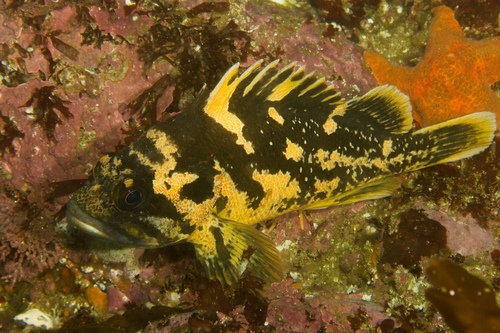
Black-and-yellow Rockfish
Sebastes chrysomelas
A vibrant sentinel of the Pacific kelp forests, the Black-and-yellow Rockfish is a master of camouflage and territory. Its bold, bumblebee-like patterns make it one of the most striking sights for coastal explorers and underwater cameras alike.
Quick Identification
Size
Typically 25-30 cm (10-12 in), reaching a maximum length of 39 cm (15 in) and weighing up to 1.5 kg (3.3 lbs).
Colors
Deep charcoal to jet-black body sharply contrasted with large, irregular bright yellow or golden-yellow blotches and spots.
Key Features
- Dark body with scattered yellow patches
- Large, bony head with prominent spines
- Sturdy dorsal fin with venomous spines
- Lacks the continuous yellow horizontal stripe found in China Rockfish
When You’ll See Them
Geographic range
Where Does the Black-and-yellow Rockfish Live?
Native to the eastern Pacific coastline of North America, the Black-and-yellow Rockfish is a true West Coast specialist. Its core range is concentrated along the California coast, extending from the cool waters near Eureka in the north down to the central reaches of Baja California, Mexico. This species is almost exclusively found in shallow coastal waters, rarely venturing deeper than 35 meters, making it one of the most accessible rockfish for coastal observers.
Basemap © OpenStreetMap contributors
Behavior
The Black-and-yellow Rockfish is a highly territorial and sedentary species that rarely wanders far from its chosen home. These fish are 'sit-and-wait' predators, often found resting on rocky ledges or tucked inside crevices within kelp forests. During the day, they are relatively lethargic, relying on their bold camouflage to blend into the shadows of the reef, but they become much more active and bold as night falls.
Socially, they are solitary and will aggressively defend their small home territories from other rockfish, including their own species. They are known for their extreme site fidelity; once an adult establishes a territory in a specific rock pile or kelp holdfast, it may stay there for years. While generally wary of humans, they can become accustomed to divers and fixed camera installations, often peering curiously at lenses from the safety of their holes.
EverydayEarth exclusive
Camera Tips
Capturing the Black-and-yellow Rockfish requires a waterproof housing or a specialized underwater camera rig. Because these fish are extremely territorial, the best strategy is to locate a specific crevice or 'apartment' in a rocky reef where a fish has already been spotted. Position your camera on a weighted tripod or magnetic mount about 2 to 3 feet away from the crevice entrance, angling it slightly upward to catch the underside of the fish’s vibrant throat and pectoral fins.
Lighting is the most critical factor for this species. Their black-and-yellow pattern is designed to disappear in high-contrast shadows. To get the best color rendition, use external LED video lights rather than a direct flash. Positioning lights at a 45-degree angle from the camera will help reveal the texture of their scales and the depth of the yellow patches without blowing out the highlights or creating backscatter from particles in the water.
If you are filming near a dock or pier, you can attract them using a 'scent bag'—a small mesh pouch filled with crushed shellfish or oily sardines suspended just out of the camera's frame. This will often draw the fish out of its hole for a clearer, full-body profile shot. Be sure to use a high frame rate (60fps or higher) if the water has a lot of surge, as this will allow you to stabilize the footage later if the camera moves slightly in the current.
Since these fish are most active during low-light transitions, set your AI camera to trigger on movement specifically during the hour before sunset. During this time, they often hover just outside their crevices to hunt, providing the perfect opportunity for a 'hero shot' against the backdrop of swaying kelp fronds.
Similar Species
Species that look similar or are commonly confused with Black-and-yellow Rockfish.
China Rockfish
Features a continuous, broad yellow stripe running from the dorsal fin down the side of the body.
Gopher Rockfish
Has a lighter brown or olive base color with pale tan or pinkish-white spots instead of bright yellow.
Calico Rockfish
Much smaller with a lighter, mottled red-brown pattern and distinct vertical bars.
Frequently Asked Questions
Record Black-and-yellow Rockfish at your habitat
Connect a camera to start building your own species record — AI identifies every visitor automatically.