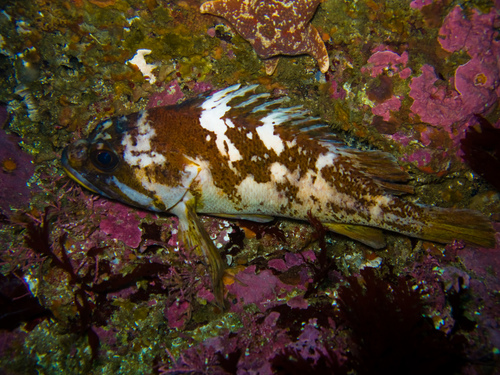
Gopher Rockfish
Sebastes carnatus
The Gopher Rockfish is the master of the California kelp forest floor, a beautifully mottled ambush predator that treats every rocky crevice like a private fortress. A favorite for coastal underwater cameras, this 'homebody' of the reef offers a fascinating glimpse into the secret life of our Pacific tide pools.
Quick Identification
Size
Typically reaches 25-30 cm (10-12 inches), with a maximum length of 40 cm (15.7 inches); weighs approximately 0.5-1.4 kg (1.1-3.1 lbs).
Colors
Mottled dark brown, olive, or reddish-brown base with distinct large patches of light pink, tan, or dull yellow; underbelly is usually a lighter creamy color.
Key Features
- Heavy-bodied with a large head and prominent dorsal spines
- Six to eight light-colored blotches along the back and sides
- Mottled brown and pink/tan coloration
- Continuous dorsal fin with deep notches between spines
When You’ll See Them
Behavior
The Gopher Rockfish is a famously sedentary and territorial resident of the Pacific rocky reefs. Unlike many of its cousins that school in open water, the Gopher is a 'homebody' that claims a specific crevice or hole as its own, rarely venturing more than a few meters from its chosen retreat. They are solitary creatures, often spending their daylight hours tucked into rocky overhangs or hidden among kelp holdfasts, waiting for prey to drift or crawl within striking distance.
For underwater observers and camera users, these fish are known for their relatively 'bold' nature; they often stay still and observe humans rather than darting away immediately. However, they are highly defensive toward other rockfish, using flared fins and body displays to protect their territory. Their social life is limited outside of the breeding season, as they prefer a life of solitary ambush hunting.
EverydayEarth exclusive
Camera Tips
Capturing the Gopher Rockfish on camera requires a specialized underwater setup, ideally positioned near the 'intertidal' or 'subtidal' zones. If you have a dock, pier, or a backyard that borders a rocky California cove, mount your camera on a weighted tripod or a fixed piling looking toward a rocky crevice. Because these fish are nocturnal, integrated infrared (IR) lights or a low-intensity external red light will allow you to see their activity without startling them or washing out their beautiful mottled colors.
Placement is everything with this species. Look for 'high-relief' areas—places where there are deep cracks in the rocks or large boulders piled together. Position the camera about 12 to 18 inches from the entrance of a suspected hole, angled slightly upward to capture the fish as it emerges. Gopher Rockfish are ambush predators, so they love to sit at the mouth of their caves. If you are using a motion-triggered system, ensure the sensitivity is high, as they often move slowly and deliberately rather than with high-speed bursts.
To guarantee a sighting, consider using a 'scent lure' rather than loose bait. A perforated PVC tube filled with smashed sardines or oily fish scraps (a 'chum pod') secured within the camera's field of view will draw them out of their holes to investigate. Because they are highly territorial, once a Gopher Rockfish claims the area in front of your camera, you are likely to see the same individual night after night. Check your housing seals regularly and use a desiccant pack inside the camera case to prevent the lens from fogging in the cold Pacific waters.
Similar Species
Species that look similar or are commonly confused with Gopher Rockfish.
Black-and-yellow Rockfish
Nearly identical in shape, but features stark yellow patches on a black background instead of the Gopher's pinkish/tan patches on brown.
Kelp Rockfish
Usually a more uniform olive-brown color without the distinct large light-colored blotches found on the Gopher Rockfish.
Brown Rockfish
Lacks the distinct light-colored blotches on the back and has a dark spot on the operculum (gill cover).
Frequently Asked Questions
Record Gopher Rockfish at your habitat
Connect a camera to start building your own species record — AI identifies every visitor automatically.