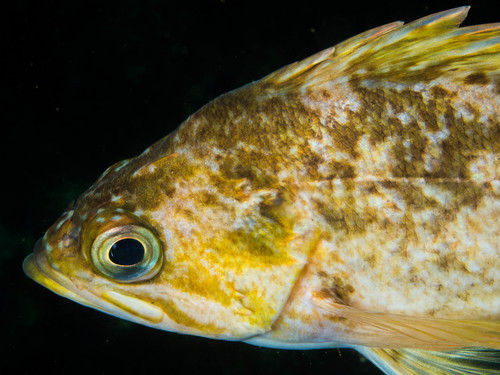
Kelp Rockfish
Sebastes atrovirens
A master of underwater camouflage, the Kelp Rockfish is the silent sentinel of the Pacific's golden forests. Often found hovering vertically among the kelp, these mottled beauties are a favorite for coastal backyard observers and scuba divers alike.
Quick Identification
Size
Typically 25-35 cm (10-14 inches) in length, reaching a maximum of 42 cm (16.5 inches); weight usually ranges from 0.5-1.5 kg (1-3 lbs).
Colors
Tan, brownish, or olive-green base with darker mottling or 'freckles' across the body; fins are usually a uniform brownish color without distinct spots.
Key Features
- Large, fan-shaped pectoral fins
- Mottled olive-to-brown camouflage pattern
- Stocky body with a relatively large mouth
- Commonly seen resting vertically among kelp fronds
When You’ll See Them
Geographic range
Where Does the Kelp Rockfish Live?
Native to the eastern Pacific Ocean, the Kelp Rockfish is primarily found along the temperate coastline of North America. Its core range extends from the cool waters of Sonoma County in Northern California down through the Southern California Bight to central Baja California, Mexico. While they are most abundant in the lush kelp forests of the Channel Islands and Monterey Bay, they are a common sight for coastal residents living near rocky shorelines and protected bays throughout this region.
Basemap © OpenStreetMap contributors
Behavior
The Kelp Rockfish is a master of patience and camouflage. Unlike many of its more active ocean neighbors, this species is relatively sedentary, often spending its day hovering motionless among the swaying blades of giant kelp. They have a unique habit of resting vertically, either head-up or head-down, to perfectly mimic the orientation of kelp stipes, making them nearly invisible to both predators and unsuspecting prey.
These fish are generally solitary and maintain small home ranges, often staying within the same patch of kelp or rocky reef for years. While they are not aggressive toward humans, they are highly territorial toward other rockfish of similar size. They are most active during the day, using their large eyes to spot small movements in the water column, though they may also feed during twilight hours if the conditions are right.
EverydayEarth exclusive
Camera Tips
Capturing high-quality footage of Kelp Rockfish requires a waterproof setup, such as an action camera (like a GoPro) inside a dive housing. If you live on the coast or have access to a private dock, the best method is to use a 'drop camera' setup. Mount your camera to a weighted PVC frame or a sturdy pole and lower it alongside pier pilings or into the edge of a kelp bed. Ensure the camera is angled slightly downward to capture the fish as they hover near the structure. Because they are curious but cautious, leave the camera stationary for at least 30 minutes to allow the fish to acclimate to its presence.
Lighting is your biggest challenge underwater. If you are filming under a dock or in a dense kelp forest, use a wide-beam video light (at least 1000-2000 lumens) to bring out the rich olive and bronze tones of the fish's skin. However, avoid pointing the light directly at the fish; instead, aim it slightly off-center to minimize 'backscatter'—the reflection of light off tiny particles in the water. For the most natural look, film on a clear day when the sun is directly overhead to allow 'god rays' to penetrate the kelp canopy.
Since Kelp Rockfish are ambush predators, you can encourage them to visit your camera site by creating a 'micro-habitat.' If local regulations allow, placing a small mesh bag of crushed shellfish near the camera will attract the small shrimp and crabs that Kelp Rockfish hunt. Set your camera to record at 60 frames per second (fps) or higher; while the fish themselves move slowly, the swaying kelp and passing baitfish look much smoother in high-frame-rate video when slowed down in post-production.
Similar Species
Species that look similar or are commonly confused with Kelp Rockfish.
Gopher Rockfish
Displays 3-5 distinct pale spots on its back and stays closer to the seafloor than the Kelp Rockfish.
Black-and-Yellow Rockfish
Has a much darker black base with bright yellow patches, unlike the tan/olive mottling of the Kelp Rockfish.
Grass Rockfish
Has a thicker body and darker green coloration with less distinct mottling, typically found in shallower tide pools.
Frequently Asked Questions
Record Kelp Rockfish at your habitat
Connect a camera to start building your own species record — AI identifies every visitor automatically.