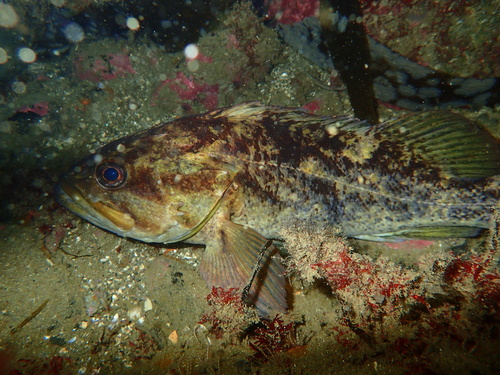
Grass Rockfish
Sebastes rastrelliger
A master of camouflage hidden within the kelp forests of the Pacific coast, the Grass Rockfish is a patient predator that blends perfectly with the rocky reefs it calls home.
Quick Identification
Size
Up to 56 cm (22 inches) in length and weighing up to 2.3 kg (5 lbs)
Colors
Mottled olive-green to dark brown or black with pale, creamy blotches; lighter belly with green or grey tones
Key Features
- Short, blunt gill rakers
- Stocky, heavy-set body shape
- Mottled green and brown camouflage
- Thick, venomous dorsal spines
- Large mouth with thick lips
When You’ll See Them
Geographic range
Where Does the Grass Rockfish Live?
Native to the Eastern Pacific coastline, the Grass Rockfish is a quintessential inhabitant of the North American West Coast. Its primary range extends from the chilly waters of Yaquina Bay, Oregon, down through the entire California coast to central Baja California in Mexico. It thrives in the shallow, oxygen-rich waters of the intertidal zone and nearshore rocky reefs, making it a common sight for coastal residents and divers alike.
Basemap © OpenStreetMap contributors
Behavior
The Grass Rockfish is a notably solitary and sedentary predator, often described as a 'sit-and-wait' hunter. Unlike many of its cousins in the rockfish family that school in open water, the Grass Rockfish spends most of its time resting directly on the seafloor or tucked deep within the protective canopy of kelp forests. They are highly territorial, frequently claiming a specific crevice or rocky ledge as their own and defending it against intruders. This lifestyle makes them a favorite for underwater observers, as they are less likely to flee than more active, nomadic fish.
Feeding primarily during the dim light of dawn and dusk, they rely on their exceptional camouflage to remain invisible to unsuspecting prey. When a small crab or fish wanders too close, the Grass Rockfish uses a powerful suction-feeding strike, opening its large mouth rapidly to inhale the victim. While they are generally wary of humans, they are often encountered by tide-poolers and pier anglers, as they inhabit much shallower waters than almost any other rockfish species.
EverydayEarth exclusive
Camera Tips
Capturing the Grass Rockfish requires an underwater setup, ideally a camera in a waterproof housing mounted to a weighted tripod or a dock piling. Because these fish are extremely territorial and sedentary, they don't move around as much as other species; once you find a 'home' crevice in a rocky area or under a pier, you are likely to see the same individual repeatedly. Position your camera at a low angle facing a rocky overhang or the edge of a kelp bed, as these are the fish's preferred hunting grounds.
To draw them into the frame, consider using a perforated PVC bait tube filled with smashed crabs or shrimp, which mimics their natural diet. This is most effective during high tide when the fish move into shallower areas to forage. Since they are master camouflagers, ensure your camera is set to a high resolution (4K) to distinguish their subtle movements against the swaying kelp. Using a wide-angle lens is recommended to capture the surrounding habitat, which helps in identifying the fish by its environment.
The best time for visibility and activity is during the early morning hours or late afternoon when the light is angled, providing better contrast for the camera's sensor. If you are filming in deeper water or under a dark pier, an external LED light source is essential. However, keep the light at a low intensity to avoid spooking the fish or causing 'backscatter' from particles in the water. Regularly cleaning the lens port is crucial, as salt buildup and algae can quickly obscure the shot in a marine environment.
Similar Species
Species that look similar or are commonly confused with Grass Rockfish.
Frequently Asked Questions
Record Grass Rockfish at your habitat
Connect a camera to start building your own species record — AI identifies every visitor automatically.