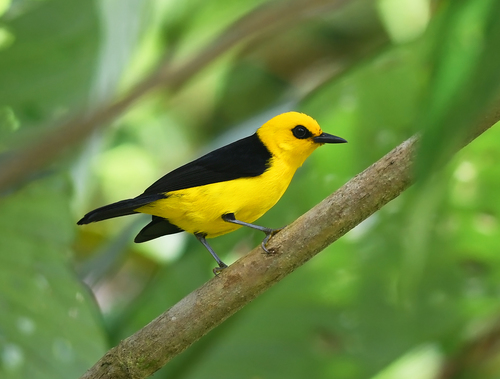
Black-and-yellow Tanager
Chrysothlypis chrysomelas
A radiant flash of gold and obsidian, the Black-and-yellow Tanager is a jewel of the Central American cloud forests. Often found in social flocks, these energetic birds bring vibrant life to the humid highland canopies of Costa Rica and Panama.
Quick Identification
Size
Length: 11.5–12.5 cm (4.5–4.9 in); Weight: 11–14 g (0.4–0.5 oz)
Colors
Males are vibrant canary-yellow with contrasting jet-black wings and tail. Females are olive-yellow above and bright yellow below.
Key Features
- Bright yellow body with solid black wings (male)
- Olive-green back with yellow underparts (female)
- Short, pointed black bill
- Small, active build
- High-pitched 'tsip' calls
When You’ll See Them
Geographic range
Where Does the Black-and-yellow Tanager Live?
This stunning species is a regional endemic, naturally found only within the lush mountain ranges of Central America. Its core territory spans the Caribbean slopes of Costa Rica and Panama, though it also inhabits the Pacific slopes in the southern parts of the Panamanian isthmus. Because it prefers the mid-elevation 'foothill' zone, it serves as a quintessential representative of the rich biodiversity found in the Talamancan montane forests.
Basemap © OpenStreetMap contributors
Behavior
Their movement is characterized by a restless, hopping rhythm. They rarely stay on one branch for more than a few seconds, constantly fluttering their wings as they glean insects from leaf surfaces or hover briefly to pluck small berries. Despite their high-altitude home, they are remarkably bold and less skittish around humans than many other forest-dwelling birds.
EverydayEarth exclusive
Camera Tips
Baiting with fruit is highly effective, but the placement must be right. Use an elevated platform feeder at least 15 feet off the ground and stock it with soft tropical fruits like overripe bananas, papaya, or oranges. These birds are social, so if you see one, keep your camera recording; several more are likely to follow in quick succession. High-speed shutter settings are essential, as their movements are incredibly fast and jerky.
For the best visual results, time your camera's active window to the early morning hours when the mist is lifting from the cloud forest. The contrast between the male's brilliant yellow plumage and jet-black wings is spectacular but can easily 'blow out' in direct, harsh noon sunlight. Setting your exposure compensation slightly lower can help preserve the detail in the bright yellow feathers during the golden hour.
Similar Species
Species that look similar or are commonly confused with Black-and-yellow Tanager.
Frequently Asked Questions
Record Black-and-yellow Tanager at your habitat
Connect a camera to start building your own species record — AI identifies every visitor automatically.