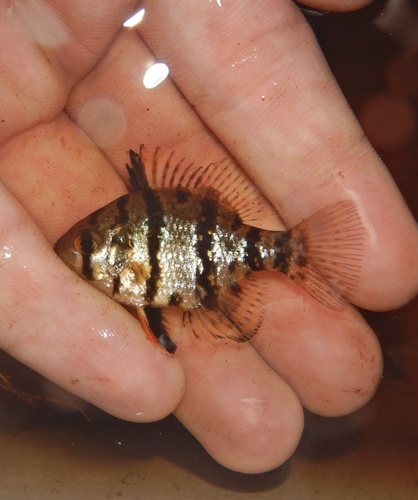
Black-banded Sunfish
Enneacanthus chaetodon
A hidden gem of the Eastern seaboard, the Black-banded Sunfish is a master of camouflage. With its striking 'jailbird' stripes and preference for mysterious tea-colored waters, it is a prized sight for any aquatic wildlife enthusiast.
Quick Identification
Size
6-10 cm (2.4-4 in) in length; typically weighs less than 30g (1 oz)
Colors
Silver to creamy white base with 6 prominent vertical black bands; males show iridescent spots and orange fin tints during breeding
Key Features
- Six distinct vertical black bands across the body
- Deep, disk-shaped and laterally compressed body
- Large eyes with a dark vertical line passing through them
- Rounded dorsal and anal fins
When You’ll See Them
Geographic range
Where Does the Black-banded Sunfish Live?
The Black-banded Sunfish is a native resident of the North American Atlantic Coastal Plain. Its core range spans from the unique Pine Barrens of New Jersey southward through the wetlands of the Carolinas and Georgia, reaching as far as central Florida. While primarily found in these eastern US states, their populations are highly localized and dependent on undisturbed, acidic freshwater habitats.
Basemap © OpenStreetMap contributors
Behavior
The Black-banded Sunfish is a notably shy and peaceful species, diverging from the aggressive reputation of its larger sunfish relatives. It is a master of 'stationary' behavior, often found hovering perfectly still among the stems of aquatic plants. This low-energy lifestyle allows it to blend into the shadows, where its vertical stripes mimic the patterns of light filtering through submerged vegetation.
Socially, they are somewhat gregarious and may form small, loose groups, though they lack the schooling instinct of minnows. During the spring spawning season, the males become more active and territorial as they sweep out small depressions in the sand or gravel to attract mates. They are highly sensitive to their environment, requiring specific acidic water conditions to thrive and reproduce.
EverydayEarth exclusive
Camera Tips
To capture the Black-banded Sunfish on camera, you will need an underwater setup or a high-quality glass aquarium observation tank. Because these fish are shy, place your camera near dense clusters of aquatic plants like bladderwort, milfoil, or water lilies. They rarely venture into open, sandy areas, so aiming your lens at the transition zone between heavy 'weed' cover and a small clearing is the best way to catch them as they patrol for larvae.
Lighting is your biggest challenge in their natural 'blackwater' habitats, which are often stained dark by tannins. If your camera is submerged, use a setup that allows for soft, diffused side-lighting to highlight the iridescence of their scales without creating backscatter in the murky water. Mid-morning is the best time for filming, as the sun is high enough to penetrate the water column but low enough to create the dramatic shadows that these fish love to hide in.
For those using an AI-powered backyard pond camera, ensure the lens is clean and positioned about 6 to 10 inches from a 'lure' area. While you shouldn't bait them with traditional food, placing a small patch of fine-leaved aquatic moss can act as a natural attractor for the tiny crustaceans they eat, bringing the sunfish into focus. Use a high frame rate setting if possible, as their movements are subtle and precise, involving quick flicks of the pectoral fins to maintain their hover.
Similar Species
Species that look similar or are commonly confused with Black-banded Sunfish.
Frequently Asked Questions
Record Black-banded Sunfish at your habitat
Connect a camera to start building your own species record — AI identifies every visitor automatically.