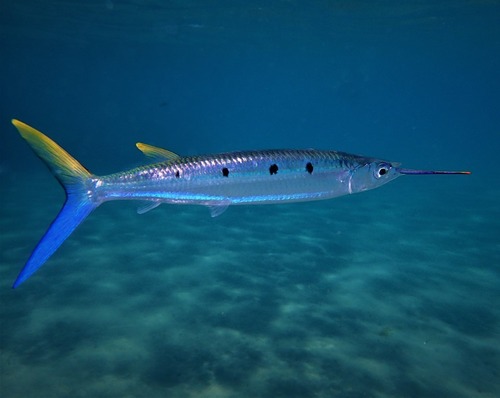
Black-barred Halfbeak
Hemiramphus far
Meet the master of the surface: a silver-clad sprinter with a unique 'beak' and striking zebra-like stripes. The Black-barred Halfbeak is a fascinating Lessepsian migrant that brings a flash of the Indo-Pacific to coastal waters everywhere.
Quick Identification
Size
Typically 25–35 cm (10–14 inches) long, with a maximum recorded length of 45 cm (18 inches); weight usually ranges between 150–500 grams.
Colors
Silvery body with a bluish-green back; distinguished by 4–9 prominent dark vertical bars on the sides and a red or orange tip on the lower jaw.
Key Features
- Elongated lower jaw forming a distinct beak
- 4 to 9 dark vertical bars along the silver flanks
- Strongly forked tail with the lower lobe longer than the upper
- Short, triangular upper jaw
When You’ll See Them
Geographic range
Where Does the Black-barred Halfbeak Live?
Native to the vast tropical and subtropical stretches of the Indo-Pacific, the Black-barred Halfbeak is found from the eastern coast of Africa through the Indian Ocean to the islands of Southeast Asia and Northern Australia. In a fascinating display of marine migration, it has also become a 'Lessepsian migrant,' successfully invading the eastern Mediterranean Sea via the Suez Canal. It is now frequently spotted along the coastlines of Egypt, Israel, and Lebanon.
Basemap © OpenStreetMap contributors
Behavior
The Black-barred Halfbeak is a highly social, schooling species that spends the majority of its life just inches below the water's surface. They are known for their incredible agility and a unique escape mechanism: when threatened by predators from below, they can leap from the water and 'skitter' across the surface using their powerful tail to maintain momentum while keeping their bodies mostly airborne.
As a diurnal species, they are most active during the day, moving in large groups to graze on floating vegetation or hunt for tiny organisms. While generally shy of humans, they are frequently seen by pier fishers and snorkelers in coastal areas. They play a vital role in the marine food web, serving as a primary food source for larger predatory fish like tuna and mackerel, as well as coastal seabirds.
EverydayEarth exclusive
Camera Tips
Capturing the Black-barred Halfbeak requires a specialized approach because they are surface-dwellers. If you have a dock or a waterfront property, mount your AI-powered camera just below the waterline facing upward or horizontally across the surface. Because they are attracted to light, a low-intensity underwater LED light can act as a lure during dawn or dusk, though they are most active in full daylight. Using a polarizing filter on your lens is essential to cut through the surface glare and reveal the fish's silver body and dark bars.
Position your camera near structures like pier pilings or at the edge of seagrass beds where these fish naturally congregate to feed. Since halfbeaks are fast-moving and schooling, set your camera to a high frame rate (at least 60fps) to capture their rapid movements and 'skittering' behavior without motion blur. AI triggers should be calibrated for 'fast-moving objects' near the top of the frame.
For the best results, place the camera in an area with calm water, such as a lagoon or protected bay. Heavy surf makes it difficult to distinguish the fish from bubbles and foam. If you are baiting an area for filming, small amounts of floating fish meal or crushed green algae can keep a school in front of your lens for an extended period, allowing the AI to get a clear identification of the vertical barring on their sides.
Similar Species
Species that look similar or are commonly confused with Black-barred Halfbeak.
Frequently Asked Questions
Record Black-barred Halfbeak at your habitat
Connect a camera to start building your own species record — AI identifies every visitor automatically.