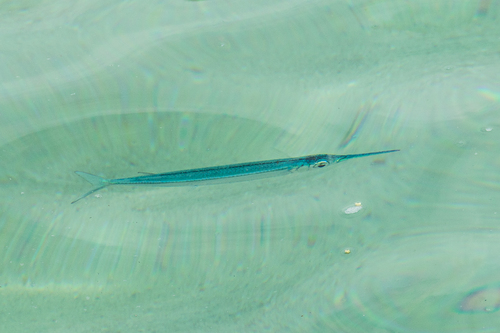
Lutke's Halfbeak
Hemiramphus lutkei
A sleek, surface-skimming marvel of the Indo-Pacific, the Lutke's Halfbeak is easily recognized by its remarkable needle-like lower jaw. These shimmering silver fish are masters of coastal camouflage and agile escapes.
Quick Identification
Size
Typically 25–40 cm (10–16 inches) in length; weight usually under 0.5 kg (1.1 lbs)
Colors
Silvery-white underside and flanks with a bluish or greenish-grey dorsal surface; the tip of the elongated lower jaw is often a vibrant red or orange
Key Features
- Extremely elongated lower jaw with a short, triangular upper jaw
- Streamlined, cylindrical body shape
- Deeply forked caudal fin with a longer lower lobe
- Large, silver scales that reflect light easily
When You’ll See Them
Geographic range
Where Does the Lutke's Halfbeak Live?
Lutke's Halfbeak is widely distributed throughout the tropical and subtropical waters of the Indo-West Pacific. Its native range extends from the eastern coast of Africa and the Red Sea across to the Gilbert Islands in the central Pacific. This species is most commonly observed in the coastal zones of northern Australia, southern Japan, Indonesia, the Philippines, and various Pacific island nations, where they thrive in the nutrient-rich interface between the open sea and the shore.
Basemap © OpenStreetMap contributors
Behavior
The Lutke's Halfbeak is a surface-dwelling specialist known for its incredible agility and speed. These fish typically congregate in small to medium-sized schools, cruising just centimeters below the water's surface. This positioning allows them to scan for floating organic matter while remaining alert for predators from below. When threatened by larger fish or birds, they are capable of 'skipping' across the water's surface, using powerful tail thrusts to launch themselves into the air in a series of short, frantic leaps.
Socially, they are non-aggressive schooling fish that rely on safety in numbers. While they are primarily marine, they are frequently seen by humans in shallow reef flats, near piers, and in coastal lagoons. They are relatively shy and will dart away at the sight of sudden shadows or movement above the waterline, making them a challenge but a rewarding subject for coastal wildlife observers.
EverydayEarth exclusive
Camera Tips
Capturing the Lutke's Halfbeak requires a specialized approach since they live exclusively at the water's surface. If you have a coastal property or access to a pier, mount your AI-powered camera on a stable piling or a floating dock facing downward at a 45-degree angle toward the water. Because these fish are highly reflective, use a polarizing filter on your lens to cut through surface glare and water reflections, which will help the AI accurately identify the species by its distinct beak and silver scales.
For the best results, place your camera near areas with floating vegetation or near seagrass beds during a rising tide. This is when halfbeaks are most likely to move into shallow areas to forage. While they are primarily diurnal, they are often attracted to artificial lights at night; if your camera has infrared capabilities or if there is ambient dock lighting, you may capture unique nocturnal behavior as they huddle near the light source for protection or to feed on attracted insects.
Use a high shutter speed or high frame rate (at least 60fps) if your camera allows. Lutke's Halfbeaks are incredibly fast and can vanish in a split second. A fast capture rate will help freeze the motion of their 'skipping' behavior. Avoid placing the camera where it will be splashed by salt spray, or ensure it is in a high-quality marine-grade waterproof housing, as salt buildup on the lens will quickly obscure the fine details of the fish's unique jaw structure.
Similar Species
Species that look similar or are commonly confused with Lutke's Halfbeak.
Frequently Asked Questions
Record Lutke's Halfbeak at your habitat
Connect a camera to start building your own species record — AI identifies every visitor automatically.