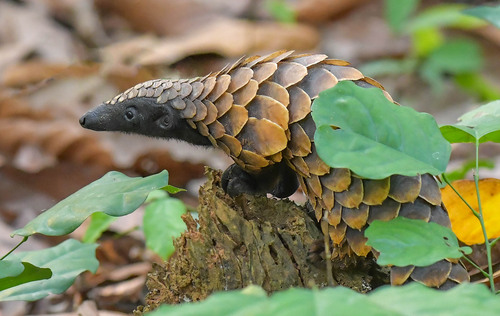
Black-bellied Pangolin
Phataginus tetradactylus
Meet the most acrobatic member of the pangolin family. With a tail longer than its body and a unique daytime schedule, the Black-bellied Pangolin is a master of life in the African canopy.
Quick Identification
Size
Body length of 30–40 cm (12–16 in) with a massive tail of 60–70 cm (24–28 in); weighs 1.2–2.5 kg (2.6–5.5 lbs).
Colors
Dark brown to nearly black scales with lighter yellowish edges; distinctive black or dark brown fur on the underbelly and inner limbs.
Key Features
- Extremely long prehensile tail, roughly twice the body length
- Dark-furred belly and limbs, unlike other African pangolins
- Large, overlapping dark scales covering the head, back, and sides
- Small, pointed head with no external ears or teeth
- Strong curved claws for climbing and digging.
When You’ll See Them
Geographic range
Where Does the Black-bellied Pangolin Live?
This arboreal specialist is native to the tropical heart of the African continent. Its range is centered within the lush Congo Basin and the humid forests of West Africa, stretching from Sierra Leone and Liberia eastward through Nigeria, Cameroon, and Gabon, and deep into the Democratic Republic of the Congo. It is a lowland specialist, almost always found in proximity to water sources where its preferred prey thrives.
Basemap © OpenStreetMap contributors
Behavior
The Black-bellied Pangolin is a fascinating outlier in the pangolin world, primarily because it is diurnal. While its cousins hide away during the day, this species is active under the sun, navigating the high canopy of the African rainforest. It is an exceptional climber, using its incredibly long, prehensile tail as a secure anchor or fifth limb while it moves between branches or hangs to reach ant nests. Because it lives high above the ground, it is rarely seen by casual observers.
These mammals are solitary and highly territorial, coming together only briefly for mating. They spend the vast majority of their lives in the trees, occasionally swimming across small forest streams to reach new foraging grounds. When threatened, they employ the classic pangolin defense—rolling into a tight, impenetrable ball of sharp scales—but they are also known to use their tail to lash out or retreat higher into the canopy where predators like leopards struggle to reach them.
EverydayEarth exclusive
Camera Tips
To capture the Black-bellied Pangolin on camera, you must think vertically. Standard ground-level trail camera sets will almost never yield a sighting of this arboreal species. Instead, mount your cameras 3 to 8 meters (10-25 feet) up in the canopy. Look for 'aerial highways'—large, horizontal or slightly inclined branches that bridge gaps between trees. These are the primary travel routes for pangolins as they move through the forest seeking new ant nests.
Since these animals are diurnal, ensure your camera is configured for high-quality daytime triggers. Use a fast trigger speed (0.3 seconds or less) and a high frame rate for video, as their movements among branches can be surprisingly quick and fluid. If your camera has a 'time-lapse' mode, consider setting it to take a photo every 5-10 minutes during peak daylight hours in areas with high canopy density, as the animal's slow, methodical movement might not always trigger a PIR sensor at long distances.
Placement near water is another secret to success. This species is frequently found in swamp forests and near riverbanks. Position your camera on a tree overlooking a slow-moving stream or a swampy clearing. While they don't respond to commercial baits, a camera placed near a large, active arboreal ant nest is essentially a stakeout at their favorite restaurant. Check for 'fresh' damage to ant nests or claw marks on the bark as indicators of a recent visit.
Similar Species
Species that look similar or are commonly confused with Black-bellied Pangolin.
Frequently Asked Questions
Record Black-bellied Pangolin at your habitat
Connect a camera to start building your own species record — AI identifies every visitor automatically.