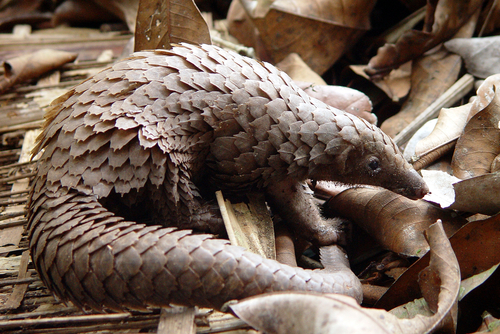
White-bellied Pangolin
Phataginus tricuspis
Often called the 'living pinecone,' the White-bellied Pangolin is a shy, scale-covered marvel of the African forest. With its prehensile tail and specialized diet, this nocturnal climber is one of the most unique mammals you'll ever capture on camera.
Quick Identification
Size
Body length 35–45 cm (14–18 in) with a 40–50 cm (16–20 in) tail; weighs 1.8–2.4 kg (4–5.3 lbs).
Colors
Scales range from light brownish-gold to dark grayish-brown; the belly, throat, and inner limbs are covered in soft white skin rather than scales.
Key Features
- Overlapping tricuspid (three-pointed) scales
- Extremely long, prehensile tail used for climbing
- Small, narrow head with no external ears
- Scaleless white underbelly and throat
When You’ll See Them
Behavior
The White-bellied Pangolin is a master of the canopy, spending much of its life high in the trees of equatorial Africa. Unlike their ground-dwelling cousins, these "scaly anteaters" use their strong, prehensile tails as a fifth limb to navigate branches with surprising agility. They are primarily solitary creatures, marking their territory with scent and coming together only for brief mating encounters. When threatened, they employ a unique defense mechanism: rolling into a tight, impenetrable ball of scales, often tucking their soft white belly safely inside.
Though they are generally shy and elusive, they are fascinating to observe if you can find them. They lack teeth entirely, instead using a sticky tongue that can be longer than their body to lap up thousands of ants and termites in a single night. In areas where humans live near forest edges, they may occasionally be spotted crossing paths or garden boundaries, though they remain wary of loud noises and bright lights.
EverydayEarth exclusive
Camera Tips
Capturing a White-bellied Pangolin on camera requires a strategy that looks both high and low. Because they are semi-arboreal, your best bet is to mount your AI camera on a sturdy tree trunk approximately 3 to 5 feet (1 to 1.5 meters) off the ground, angled slightly downward toward a fork in the tree or a known climbing path. Look for "scratch marks" on the bark or hollow logs near the base of trees, which indicate active foraging or nesting sites. If you have a known ant or termite mound on your property, this is the gold-standard location for a camera setup.
Since these animals are strictly nocturnal, ensure your camera's infrared (IR) flash is optimized. High-intensity IR can sometimes "wash out" the reflective scales, making it hard for AI models to identify the species. If your camera allows, use a medium-range flash setting to preserve the intricate detail of their tricuspid scales. Set your trigger speed to the fastest possible setting; while they move slowly when feeding, they can be surprisingly quick when crossing open ground between trees.
While baiting pangolins is difficult because they only eat live insects, you can "lure" them by maintaining a natural, chemical-free environment that supports healthy ant populations. Avoid using pesticides, as these are toxic to the species and remove their primary food source. Check your footage during the rainy season particularly; the damp soil and increased insect activity often bring them lower to the ground where your camera has a better field of view.
In terms of video settings, a 10-15 second clip is ideal. This gives the AI enough time to recognize the unique rolling gait of the pangolin or the way it uses its tail for balance. Because they are rare and very sensitive to disturbance, avoid checking the camera too frequently—human scent can deter them for several days. A weekly check is usually sufficient to capture their secret movements without disrupting their routine.
Similar Species
Species that look similar or are commonly confused with White-bellied Pangolin.
Frequently Asked Questions
Record White-bellied Pangolin at your habitat
Connect a camera to start building your own species record — AI identifies every visitor automatically.