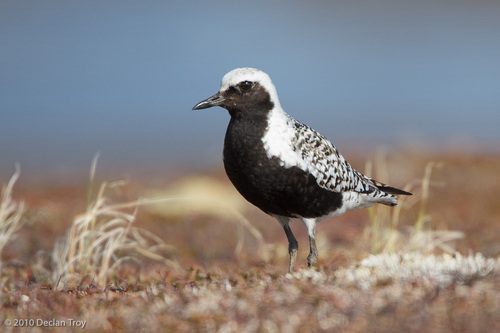
Black-bellied Plover
Pluvialis squatarola
A master of global travel, the Black-bellied Plover is the largest of North America's plovers, known for its striking tuxedo-like breeding plumage and haunting three-note whistle. Watch for this watchful sentinel as it guards the shoreline on its journey from the Arctic tundra to the southern coasts.
Quick Identification
Size
Length: 10.6-11.4 in (27-29 cm); Wingspan: 28-33 in (71-83 cm); Weight: 5.6-9.9 oz (160-280 g)
Colors
In breeding season, they show a striking black face, neck, and belly with a mottled silver and black back. In winter, they turn a uniform salt-and-pepper gray with white underparts. Black feathers under the wing ('armpits') are present year-round.
Key Features
- Large head with a short, thick black bill
- Black 'armpits' (axillary feathers) visible only in flight
- Distinctive white rump and wing stripe seen from above
- Small hind toe, which is absent in other North American plovers
- Stocky, hunched posture while standing
When You’ll See Them
Geographic range
Where Does the Black-bellied Plover Live?
Native to the northernmost reaches of the globe, the Black-bellied Plover breeds across the Arctic tundra of Alaska, Canada, and Russia. This species is one of the world's most widely distributed shorebirds, migrating south to spend the winter along the coastlines of nearly every continent, including North and South America, Africa, Australia, and Southern Asia. In the United States, they can be found along the Atlantic, Pacific, and Gulf coasts during the migration and winter months, and are rarely seen far inland except near the Great Lakes.
Basemap © OpenStreetMap contributors
Behavior
The Black-bellied Plover is a wary and watchful shorebird, often serving as the 'sentinel' for mixed flocks. If a predator or human approaches, this plover is usually the first to give a loud, whistling alarm call and take flight, alerting all other birds in the vicinity. Unlike many other shorebirds that forage in dense, frantic clusters, these plovers are typically spaced out across a mudflat, maintaining a personal territory even while feeding.
Their hunting technique is the classic plover 'run-stop-peck.' They use their large eyes to scan the surface for movement, sprint a short distance, stop abruptly to tilt their head, and then jab at the sand to pull out a worm or crustacean. They are relatively solitary compared to sandpipers, though they may roost together in large numbers during high tide when foraging ground is unavailable.
While they are mostly silent when feeding, their flight call—a plaintive, three-syllable whistle—is one of the most iconic sounds of the coastline. Because they are so cautious, they rarely allow close human approach, making them a challenging but rewarding subject for wildlife observers and photographers.
EverydayEarth exclusive
Camera Tips
Capturing the Black-bellied Plover on camera requires an understanding of tidal patterns. Because these birds feed on the mudflats exposed by receding water, your best bet is to place your camera near the high-tide line or along known 'roosting' spots where birds gather to wait out high water. A ground-level or very low-profile mount is essential to capture their perspective, as they are relatively short birds. Angle the camera slightly upward if placing it on the sand to get that intimate, eye-level shot that makes for professional-grade wildlife photography.
Standard trail camera baits like birdseed or suet will not work for this species, as they are strict carnivores of the shoreline. Instead, look for 'natural lures' like tide pools or the edges of salt marshes where invertebrates are most active. If you have a private beachfront or dock area, placing your camera near a patch of wet sand that stays damp during low tide can attract them as they hunt for worms. High-quality video settings are recommended to capture their unique 'run-stop-peck' movement, which is a key identifying behavior.
Because these birds are active both day and night depending on the moon and tides, ensure your camera has a high-quality infrared flash that won't spook them. They are extremely wary birds; any unnatural object appearing suddenly in their environment may cause them to avoid the area for days. Use natural camouflage like driftwood, seaweed, or shells to disguise your camera housing. During the spring migration (April-May), you may be lucky enough to capture them in their stunning black-and-silver breeding plumage, which provides a much more dramatic image than their winter gray.
Similar Species
Species that look similar or are commonly confused with Black-bellied Plover.
Frequently Asked Questions
Record Black-bellied Plover at your habitat
Connect a camera to start building your own species record — AI identifies every visitor automatically.