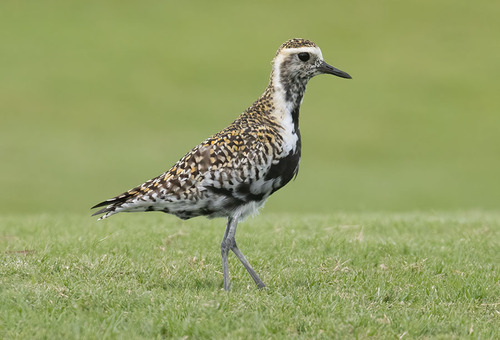
Pacific Golden-Plover
Pluvialis fulva
A golden-spangled marathon flyer that turns suburban lawns into its personal winter territory. This resilient shorebird connects the Arctic tundra to the tropical Pacific with one of the most impressive migrations in the animal kingdom.
Quick Identification
Size
Length: 23–26 cm (9–10 in); Wingspan: 60–72 cm (24–28 in); Weight: 100–220 g (3.5–7.8 oz)
Colors
Upperparts are mottled with gold, black, and brown. In breeding plumage, males have a striking jet-black face and underparts bordered by a crisp white stripe; females are similar but usually less intensely black. During the non-breeding season, both sexes fade to a more uniform buffy-brown with golden speckling.
Key Features
- Spangled golden and black back feathers
- Long, dark slender legs
- Large dark eyes adapted for spotting movement
- Short, straight black bill
- Strong white 'eyebrow' stripe in breeding plumage
When You’ll See Them
Behavior
Pacific Golden-Plovers are extraordinary long-distance migrants, often flying non-stop from Arctic breeding grounds to the Pacific Islands, including Hawaii, where they are affectionately known as 'Kōlea.' They are highly territorial during the winter months, frequently returning to the exact same backyard, park, or golf course year after year. Watching them defend these small patches of turf from other plovers is a fascinating display of avian 'property rights.'
On the ground, they exhibit a classic 'run-stop-peck' foraging rhythm. They stand perfectly still, scanning the grass for movement, then dash forward to snatch an insect. Unlike many shy shorebirds, the Pacific Golden-Plover can become quite accustomed to human presence, often foraging just a few feet away from people on well-manicured lawns or beaches.
EverydayEarth exclusive
Camera Tips
Capturing the Pacific Golden-Plover requires a ground-level approach. Because these birds spend 99% of their time on the turf, you should mount your camera no higher than 6 to 12 inches off the ground. A 'worm's eye view' not only provides a more intimate perspective of the bird but also ensures that the camera's motion sensor is triggered by their quick, low-profile movements across the grass. If you are using a trail camera, look for a flat area of short-mown lawn or a coastal path where you have seen them foraging regularly.
Since these birds are highly territorial, if you see one in your yard, it likely 'owns' that space for the season. Position your camera near a favorite lookout point—often a small mound, a rock, or a specific patch of open grass where the bird stands still to survey its territory. Unlike many birds, they aren't attracted to traditional feeders, so your best 'lure' is a healthy, well-watered lawn that naturally attracts the earthworms and insects they crave. During particularly hot or dry spells, a shallow ground-level birdbath or a slow-dripping mister can be an excellent way to draw them into your camera’s frame.
Set your camera to 'Burst Mode' or high-speed photo capture. The Pacific Golden-Plover’s foraging behavior is erratic; they move in sudden, fast bursts followed by total stillness. Video mode is also highly recommended to capture their unique head-bobbing and 'foot-trembling' behavior, which they use to vibrate the ground and coax insects to the surface. To get the best colors, ensure your camera is positioned with the sun at its back, as the golden flecks in their plumage truly shimmer in direct morning or late afternoon light.
Similar Species
Species that look similar or are commonly confused with Pacific Golden-Plover.
American Golden-Plover
Very similar, but has shorter legs and longer wings that extend further past the tail when perched.
Black-bellied Plover
Larger and chunkier with a heavier bill; lacks the distinct golden flecking, appearing more silver-grey in non-breeding plumage.
Killdeer
Easily distinguished by two bold black breast bands and a brownish-orange rump, rather than golden speckles.
Frequently Asked Questions
Record Pacific Golden-Plover at your habitat
Connect a camera to start building your own species record — AI identifies every visitor automatically.