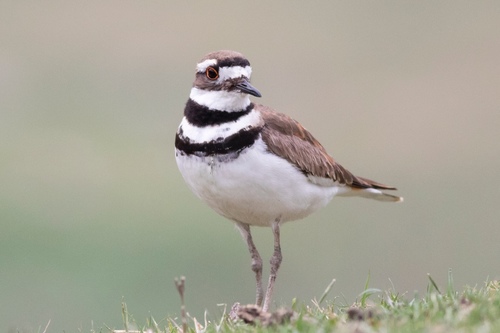
Killdeer
Charadrius vociferus
Meet the most dramatic bird in your neighborhood. Famous for its piercing cry and its clever 'broken-wing' trick, the Killdeer is a charismatic shorebird that has traded the beach for your backyard.
Quick Identification
Size
Length: 20-28 cm (8-11 in); Wingspan: 59-63 cm (23-25 in); Weight: 75-128 g (2.6-4.5 oz)
Colors
Brown upperparts with rufous fringes; white underparts; two prominent black breast bands; white and black head patches; orange-buff rump visible in flight
Key Features
- Two distinct black bands across the white breast
- Large, dark eyes with a bright red orbital ring
- Long, slender flesh-colored legs
- Slender black bill and a long, pointed tail
When You’ll See Them
Geographic range
Where Does the Killdeer Live?
The Killdeer is native to North America, with a massive range extending from southeastern Alaska and southern Canada throughout the entire United States and Mexico. While northern populations are migratory, moving toward the southern U.S. and Central America for the winter, many populations in the Caribbean and coastal South America remain resident year-round. These adaptable birds have successfully colonized a variety of human-modified landscapes across the Western Hemisphere, making them one of the most widespread plovers on the continent.
Basemap © OpenStreetMap contributors
Behavior
The Killdeer is a master of terrestrial living, often found far from the water sources favored by its shorebird relatives. They are famously vocal, frequently emitting a shrill, two-syllable "kill-deer" call that can be heard day or night. While they are technically shorebirds, they are remarkably well-adapted to human landscapes, often nesting in gravel driveways, golf courses, and even on flat, gravel-covered rooftops.
Perhaps their most famous behavior is the "broken-wing act." When a predator or human gets too close to their ground-nest, the parent will drag its wing along the ground and emit distress calls to appear injured. This theatrical performance successfully lures threats away from the camouflaged eggs; once the intruder is at a safe distance, the Killdeer miraculously "heals" and flies away. They are also known for their "run-stop-peck" foraging rhythm, moving in quick bursts across open ground.
EverydayEarth exclusive
Camera Tips
To capture high-quality footage of a Killdeer, you must think like a ground-dweller. Because these birds spend almost all of their time on the ground and rarely perch in trees, your camera should be mounted no more than 6 to 12 inches off the turf or gravel. A wide-angle lens is preferred to capture their sudden, erratic running patterns. If you are setting up in a backyard, look for open areas with very short grass or patches of bare dirt and gravel where they like to forage for invertebrates.
Standard bird feeders won't attract Killdeer since they are insectivores, so skip the seeds. Instead, you can attract them by maintaining a "wilder" patch of short-mown grass or a shallow, muddy birdbath at ground level. During the spring, keep an eye out for "scrapes"—small depressions in gravel or soil where they lay their highly camouflaged eggs. If you find a nest, place your camera at a respectful distance (at least 10-15 feet) using a telephoto setting if possible, to avoid stressing the parents or triggering the broken-wing display.
Because Killdeer are known to be active and vocal after dark, especially during a full moon, ensure your camera's infrared night vision is optimized. A fast trigger speed is essential; these birds move in sudden, high-speed sprints. Set your camera to take short video clips or multi-shot bursts (3-5 photos) to catch them in the act of foraging or performing their unique bobbing motion when they are alerted.
Similar Species
Species that look similar or are commonly confused with Killdeer.
Frequently Asked Questions
Record Killdeer at your habitat
Connect a camera to start building your own species record — AI identifies every visitor automatically.