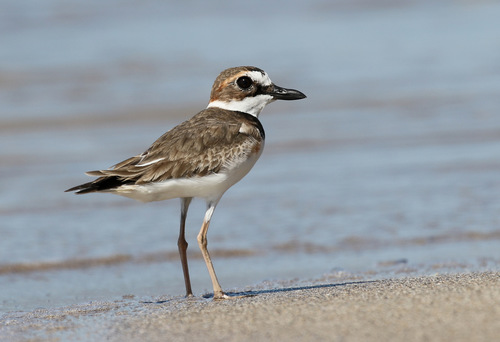
Wilson's Plover
Anarhynchus wilsonia
Meet the beach's most dedicated crab-hunter. With its signature heavy bill and striking single band, the Wilson's Plover is a master of the coastal dunes.
Quick Identification
Size
Length: 6.7-7.9 in (17-20 cm); Wingspan: 17.7-18.9 in (45-48 cm); Weight: 1.9-2.5 oz (55-70 g)
Colors
Sandy grayish-brown upperparts and bright white underparts. Breeding males feature a thick black breast band and a black bar on the forehead; females and non-breeding males have brown bands.
Key Features
- Oversized, heavy black bill used for crushing crab shells
- Single broad breast band across the neck
- Long, pale pinkish or flesh-colored legs
- Distinctive white 'eyebrow' stripe above dark eyes
When You’ll See Them
Behavior
Wilson's Plovers are the specialists of the shorebird world, easily distinguished by their 'run-stop-peck' foraging rhythm and their unusually large bills. Unlike many other shorebirds that travel in massive, swirling flocks, Wilson's Plovers are relatively solitary or travel in pairs. They are highly territorial during the nesting season, often choosing the dry, upper parts of the beach or salt flats to lay their well-camouflaged eggs directly in the sand.
They are famous for their dramatic 'broken-wing' display. If a predator or a curious human gets too close to their nest, the adult will limp away, dragging its wing and chirping piteously to lure the threat away from the chicks. Once the intruder is at a safe distance, the bird miraculously 'recovers' and flies off. They are remarkably hardy birds, capable of thriving in the intense heat of open, sun-baked salt pans where few other species can survive.
EverydayEarth exclusive
Camera Tips
To capture the best footage of a Wilson's Plover, your camera placement must be low. These birds spent 99% of their time on the ground, so a standard fence-post mount will only give you a 'bird's eye view' that lacks intimacy. Use a ground-stake mount or a low tripod to position your camera just 6 to 10 inches above the sand. Aim your lens toward the 'wrack line'—the line of seaweed and debris left by the high tide—as this is a primary hunting ground for the insects and small crustaceans they love.
Timing is everything with coastal species. Instead of just focusing on the clock, sync your camera checks with local tide charts. The two hours following a receding high tide are the most active, as the retreating water exposes fresh mudflats and 'traps' fiddler crabs. Position your camera facing away from the sun (North or South) to prevent the intense beach glare from washing out the image. If your camera has a 'burst mode' or high-speed trigger, enable it; these birds move in sudden, erratic dashes that can easily blur on slower sensors.
While we don't recommend baiting shorebirds with food (which can attract nest-raiding predators like raccoons or gulls), you can lure them by finding their 'sweet spot.' Look for areas on the back-beach with sparse vegetation or near the edges of salt pans. If you have a private beachfront area, providing a very shallow, clean water basin buried level with the sand can attract them for bathing and drinking, especially during the hottest part of the afternoon. However, always keep your equipment at a respectful distance during nesting season (late spring) to ensure you don't cause the parents to abandon their eggs.
Similar Species
Species that look similar or are commonly confused with Wilson's Plover.
Killdeer
The Killdeer has two black breast bands instead of one and is commonly found in grassy inland areas like lawns and parks.
Semipalmated Plover
Much smaller with a tiny, orange-based bill and bright orange-yellow legs, unlike the Wilson's heavy black bill and pinkish legs.
Piping Plover
Much paler 'sand' color with a very short, orange-tipped bill and orange legs; lacks the Wilson's massive black beak.
Frequently Asked Questions
Record Wilson's Plover at your habitat
Connect a camera to start building your own species record — AI identifies every visitor automatically.