Piping Plover
Charadrius melodus
A master of coastal camouflage, the Piping Plover is a tiny shorebird with a big personality. Watch for their lightning-fast sprints and iconic 'peep-lo' call across North America's sandy shores.
Quick Identification
Size
Length: 6.7-7.1 in (17-18 cm); Wingspan: 14-16 in (36-41 cm); Weight: 1.5-2.2 oz (43-63 g)
Colors
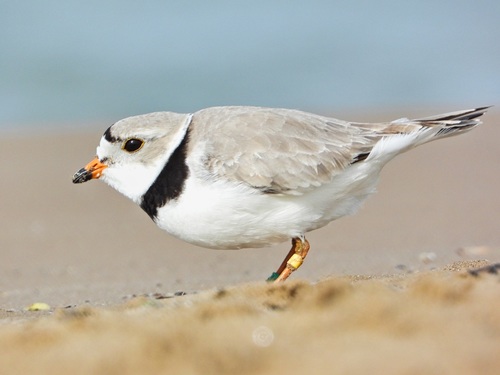
Sand-colored or pale gray upperparts, white underparts, yellow-orange legs, and a black forehead band. Males typically display a thicker, more complete black breast band than females during breeding.
Key Features
- Single black neck band
- Pale sandy-gray plumage
- Bright orange legs
- Short orange bill with a black tip
- Sparrow-sized with a stocky build
When You’ll See Them
Behavior
Piping Plovers are characterized by their distinct 'run-and-pause' foraging style. They dart across the sand with surprising speed, stop abruptly to scan for movement, and then peck at the ground to snatch up small invertebrates. They are highly territorial during the nesting season, often performing elaborate displays to defend their space.
To protect their young, these birds are famous for the 'broken-wing' act. If a predator or human gets too close to a nest, an adult will limp away from the site, dragging its wing and chirping loudly to lure the threat away from the camouflaged eggs or chicks. Once the intruder is at a safe distance, the bird miraculously 'recovers' and flies off.
EverydayEarth exclusive
Camera Tips
Capturing a Piping Plover on camera requires a blend of patience and extreme caution. Because these birds are federally protected and highly sensitive to disturbance, you should never approach a nesting site. Instead, position your camera near the 'wrack line'—the line of seaweed and debris left by high tide—where plovers frequently forage for insects. Set your camera at a very low height, ideally just 6 to 12 inches off the ground, to capture their perspective and avoid overshooting their small frames.
High trigger speeds are essential for these birds. They move in quick, erratic bursts, and a slow camera will result in nothing but a 'ghost' blur of feathers. Aim for a trigger speed of 0.2 seconds or faster. Since they blend perfectly with the sand, look for areas with high contrast, such as near darker pebbles or wet sand, to help the AI detection software lock onto the bird’s movement. A wide-angle lens is often better than a narrow one, as it captures the bird's environment and gives you a better chance of catching them as they zip through the frame.
Since Piping Plovers are diurnal, focus your efforts on daylight hours. They do not respond to traditional backyard baits, and using food to lure them is often illegal due to their protected status. Instead, focus on natural 'funnels' like the gaps between dunes or narrow stretches of beach between the water and the vegetation line. If you are using a trail camera in a coastal backyard, ensure it is weather-proofed against salt spray, which can quickly corrode electronics. Always check local beach regulations before placing a camera, as many plover nesting areas are strictly off-limits to any human foot traffic during the spring and summer.
Similar Species
Species that look similar or are commonly confused with Piping Plover.
Killdeer
Killdeer are larger, darker brown, and possess two black breast bands instead of one.
Semipalmated Plover
Semipalmated Plovers have much darker, mud-colored backs and darker faces compared to the pale, sandy Piping Plover.
Snowy Plover
Snowy Plovers have a thinner black bill and dark gray/black legs, unlike the orange legs of the Piping Plover.
Frequently Asked Questions
Record Piping Plover at your habitat
Connect a camera to start building your own species record — AI identifies every visitor automatically.