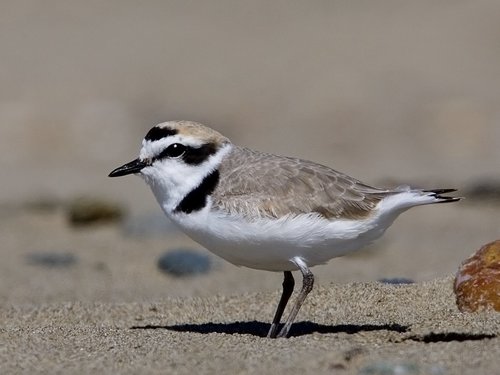
Snowy Plover
Anarhynchus nivosus
A tiny, sand-colored phantom of the shoreline, the Snowy Plover is one of the most resilient and rare shorebirds in the Americas. Watching one dash across a sun-bleached beach is a masterclass in coastal camouflage and survival.
Quick Identification
Size
Length: 15-17 cm (5.9-6.7 in) | Wingspan: 34-35 cm (13.4-13.8 in) | Weight: 34-58 g (1.2-2.0 oz)
Colors
Pale sandy-gray upperparts with white underparts. Black ear patches, forehead bar, and partial neck collars (darkest in breeding males; browner or faint in females and non-breeding birds).
Key Features
- Tiny, pale shorebird with a thin black bill
- Dark gray to black legs
- Partial black collar that does not meet across the chest
- Large dark eyes with a white 'eyebrow' stripe
When You’ll See Them
Behavior
The Snowy Plover is a master of the 'run-and-pause' foraging technique. They dart across open sand or salt flats with incredible speed, suddenly stopping to snatch an insect or crustacean before resuming their blur-like motion. Unlike many shorebirds that probe deep into the mud, the Snowy Plover relies on its keen eyesight to spot movement on the surface, making them fascinating to watch through a high-speed camera lens.
These birds are highly territorial during the breeding season and are famous for their 'broken-wing' display. If a predator or human gets too close to their camouflaged nest—which is often just a shallow scrape in the sand—the adult will limp away, dragging a wing to lure the threat away from the eggs. Socially, they may gather in small flocks during the winter, but they generally maintain a respectful distance from one another, blending perfectly into the pale beach landscape.
EverydayEarth exclusive
Camera Tips
To capture high-quality footage of a Snowy Plover, you must think like a ground-dweller. Because these birds are only a few inches tall, mounting your camera at eye level—just 6 to 10 inches off the ground—is essential. Use a sturdy ground stake or a small tripod weighed down with sandbags. Position the camera facing toward the 'wrack line' (the line of dried kelp and debris left by the tide) or near shallow puddles on salt flats, as these are their primary hunting grounds.
Since Snowy Plovers are incredibly fast, your camera settings need to be optimized for action. Use a high shutter speed or a video setting of at least 60fps to prevent their rapid leg movements from becoming a blur. Lighting can be tricky on open beaches; the white sand can reflect intense light, often 'blowing out' the bird's pale plumage. If your camera allows, set the exposure compensation to -0.3 or -0.7 to preserve the delicate details of their feathers during the brightest parts of the day.
Ethical placement is the most important factor for this species. Snowy Plovers are often federally protected and highly sensitive to disturbance. Never place a camera directly next to a known nest or in restricted nesting 'exclosures.' Instead, set up in public-access foraging areas. If you are lucky enough to have a backyard that borders a beach or salt marsh, a very shallow, ground-level water feature filled with fresh water can be an excellent lure, as these birds occasionally seek out fresh water to bathe and drink.
Lastly, consider the elements. Blowing sand and salt spray can quickly damage camera lenses and seals. Use a protective housing and check the lens frequently for salt buildup. If you are monitoring an inland population on salt flats, be aware of heat shimmer during the midday sun, which can distort your images; focus your recording sessions on the early morning or late afternoon when the air is clearer and the light is golden.
Similar Species
Species that look similar or are commonly confused with Snowy Plover.
Piping Plover
Piping Plovers have bright orange-yellow legs, whereas Snowy Plovers have dark gray or black legs.
Killdeer
Killdeer are significantly larger and have two bold black breast bands instead of the Snowy Plover's single, broken collar.
Semipalmated Plover
Semipalmated Plovers have much darker chocolate-brown backs and a thicker, orange-based bill.
Frequently Asked Questions
Record Snowy Plover at your habitat
Connect a camera to start building your own species record — AI identifies every visitor automatically.