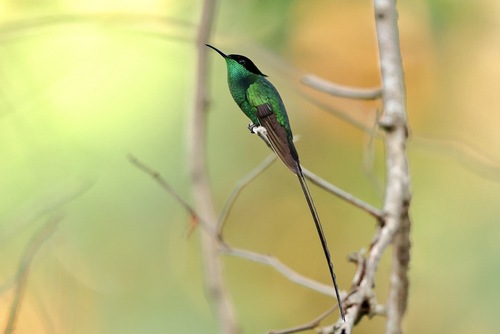
Black-billed Streamertail
Trochilus scitulus
Known locally as the 'Doctor Bird,' the Black-billed Streamertail is an emerald-hued icon of eastern Jamaica. With its signature long tail streamers and high-speed aerial acrobatics, it is one of the most mesmerizing species you can spot in a tropical garden.
Quick Identification
Size
Body length 9–10 cm (3.5–4 in); males with streamers reach 25 cm (10 in); weight 3–5 g (0.1–0.18 oz)
Colors
Iridescent emerald green body, velvet black crown, and jet black bill; males have two extremely long black tail feathers; females have white underparts and shorter tails.
Key Features
- Extremely long, scalloped black tail streamers on males
- Entirely black bill (no red)
- Velvet black cap extending to the nape
- Loud 'whirring' sound made by wings in flight
When You’ll See Them
Geographic range
Where Does the Black-billed Streamertail Live?
This bird is a Caribbean treasure found exclusively on the island of Jamaica. Within the island, it is a narrow endemic, restricted entirely to the humid eastern parishes of Portland, St. Thomas, and the eastern edge of St. Mary. It is effectively separated from its close relative, the Red-billed Streamertail, by the Blue Mountain range and the Rio Grande valley.
Basemap © OpenStreetMap contributors
Behavior
The Black-billed Streamertail is a high-energy aerialist, spending much of its day darting between nectar-rich flowers. It is famously territorial, with males vigorously defending their preferred feeding patches from other hummingbirds and even large insects. They are known for their remarkable 'whirring' or 'humming' sound, produced by the vibration of their unique primary feathers as they fly.
In social interactions, males perform elaborate courtship displays, fluttering their long tail streamers to attract mates. While they are wild birds, they have adapted well to human presence in Jamaica's eastern parishes and are frequent visitors to backyard gardens and sugar-water feeders. Their intelligence is evident in their foraging routes, as they often follow a 'trap-lining' strategy, visiting specific flowers in a predictable sequence throughout the day.
EverydayEarth exclusive
Camera Tips
To capture the Black-billed Streamertail on a backyard camera, placement is everything. Position your camera approximately 12 to 18 inches away from a nectar feeder or a cluster of favorite flowers like Hibiscus, Shrimp Plant, or Ginger Lily. Because these birds move with incredible speed, use a camera with a high frame rate or a 'fast shutter' setting to avoid a green blur. If your camera supports it, 60fps video is the best way to see the elegant movement of the male's tail streamers.
Angling your camera to catch the light is crucial for showing off the bird's iridescence. Try to set up your camera facing away from the sun so the light hits the bird's back and throat feathers, which will make them shimmer with brilliant emerald and gold tones. Avoid deep shade, as the bird will look like a dark silhouette; instead, look for 'dappled sunlight' areas where the colors can truly pop without being washed out.
Be patient with the tail. The male's streamers are its most iconic feature but can easily hang out of the frame. Set your camera's field of view wide enough to account for an extra 6-7 inches of tail trailing behind the bird. If you notice a male repeatedly using a specific twig as a lookout post—a common behavior for this territorial species—mount a second camera focused specifically on that perch for the best high-resolution stills of the bird at rest.
Similar Species
Species that look similar or are commonly confused with Black-billed Streamertail.
Frequently Asked Questions
Record Black-billed Streamertail at your habitat
Connect a camera to start building your own species record — AI identifies every visitor automatically.