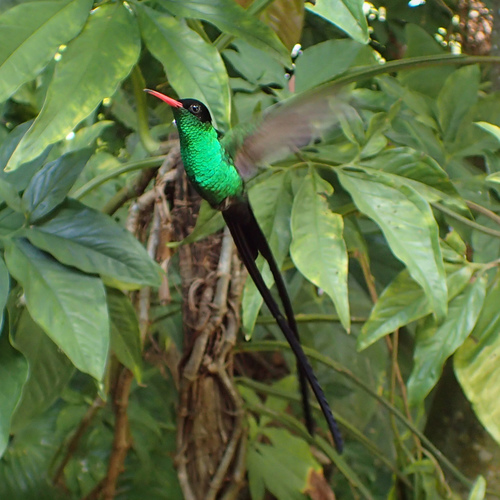
Red-billed Streamertail
Trochilus polytmus
Meet the 'Doctor Bird,' Jamaica's shimmering national icon. With its legendary tail streamers and vibrant emerald plumage, the Red-billed Streamertail is a Caribbean masterpiece of flight and color.
Quick Identification
Size
Body length 11-13 cm (4.5-5 in); males with tail streamers reach 25 cm (10 in); weight 4-6 g
Colors
Males are iridescent emerald green with a velvet black crown and long black tail streamers; females have bronze-green upperparts and white underparts.
Key Features
- Two extremely long, black scalloped tail streamers in males
- Bright coral-red bill with a black tip
- Iridescent emerald-green body plumage
- Distinctive velvet-black crest on the head
- Wings produce a unique humming or whirring sound in flight
When You’ll See Them
Geographic range
Where Does the Red-billed Streamertail Live?
The Red-billed Streamertail is a proud endemic species found only on the Caribbean island of Jamaica. It is remarkably widespread across the island's diverse topography, thriving everywhere from the humid coastal lowlands to the misty heights of the Blue Mountains. While it is the most common hummingbird in Jamaica, it is uniquely absent from the extreme eastern tip of the island, where it is replaced by its close relative, the Black-billed Streamertail.
Basemap © OpenStreetMap contributors
Behavior
The Red-billed Streamertail, affectionately known in Jamaica as the 'Doctor Bird,' is a bold and highly territorial hummingbird. Males are famous for their dramatic aerial displays, where they use their elongated tail feathers to create a distinct humming sound that serves as both a territorial warning and a courtship signal. They are often seen darting aggressively at other birds, including species much larger than themselves, to defend prime nectar-producing flowers.
These birds are remarkably comfortable around human habitation and are frequent visitors to backyard gardens and verandas. Between feeding bouts, they prefer to perch on high, exposed twigs where they can survey their territory. Their social structure is largely solitary outside of mating, and they do not form long-term pair bonds, with the female taking sole responsibility for nest building and chick rearing.
EverydayEarth exclusive
Camera Tips
To capture the stunning iridescent green of the Red-billed Streamertail, camera placement is critical. Position your device within three to five feet of a consistent nectar source, such as a sugar-water feeder or a cluster of flowering Blue Mahoe. Because these birds move with incredible speed, angling the camera to capture a lateral profile is best; this allows the AI to clearly identify the male's long streamers and the characteristic red bill against the background.
Lighting is the most important factor for high-quality hummingbird footage. Aim to have the sun behind the camera or use bright, indirect light to illuminate the bird's feathers, which will bring out the brilliant emerald shine. Avoid placing the camera where it faces directly into the sun, as the resulting silhouette will obscure the bird's vibrant colors. If your camera allows for high-frame-rate settings, use them to reduce the motion blur of their rapid wingbeats.
Beyond feeders, look for 'sentinel perches.' Males often return to the same bare branch or wire to rest and guard their territory. Setting up a camera near these preferred perching spots offers a rare chance to capture the bird in a still position, providing the most detailed images of the velvet-black crest and the intricate texture of the streamers. Early morning, just after sunrise, is the peak window for activity as the birds are most active while refueling after the night.
Similar Species
Species that look similar or are commonly confused with Red-billed Streamertail.
Black-billed Streamertail
Features an entirely black bill and is restricted to the eastern tip of Jamaica.
Vervain Hummingbird
Much smaller (the second smallest bird in the world) and lacks the long tail streamers.
Jamaican Mango
Larger and stockier with a curved black bill and a dark, magenta-tinted tail instead of streamers.
Frequently Asked Questions
Record Red-billed Streamertail at your habitat
Connect a camera to start building your own species record — AI identifies every visitor automatically.