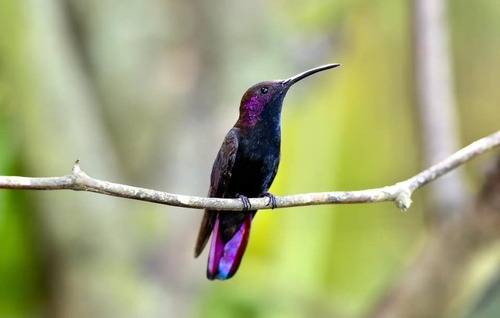
Jamaican Mango
Anthracothorax mango
A jewel of the Caribbean, the Jamaican Mango is a large, iridescent hummingbird endemic to the island of Jamaica. Known for its deep violet throat and bold personality, it is a frequent and charismatic visitor to island gardens.
Quick Identification
Size
11-12 cm (4.3-4.7 in) in length; weighs approximately 8-9 g (0.28-0.32 oz)
Colors
Deep purple-black body with iridescent violet/magenta throat and breast; dark bronze-green back and wings; dark tail with a reddish-purple sheen
Key Features
- Large, slightly decurved black bill
- Iridescent magenta-violet throat and upper chest
- Dark, stocky body compared to other hummingbirds
- No elongated tail streamers
When You’ll See Them
Geographic range
Where Does the Jamaican Mango Live?
Native to the Caribbean, the Jamaican Mango is an island endemic found exclusively on Jamaica. It thrives across the entire landmass, from the arid coastal mangroves to the lush, mid-elevation hillsides. While it is most abundant in the lowlands, it is a frequent visitor to backyard gardens in major residential areas, ensuring it remains one of the most recognized birds in the country.
Basemap © OpenStreetMap contributors
Behavior
The Jamaican Mango is a bold and territorial hummingbird known for its assertive nature around feeding sites. Unlike some smaller, more timid species, this bird will actively defend a patch of flowers or a backyard feeder from intruders, including larger bird species. They are highly maneuverable fliers, capable of hovering for extended periods while extracting nectar with their specialized bills.
These birds are generally solitary, coming together only for brief mating encounters. In suburban environments, they have become remarkably well-adapted to human presence, often perching on low-hanging wires or exposed branches to keep watch over their territory. Their flight is characterized by powerful, audible wingbeats that distinguish them from the smaller hummingbirds on the island.
EverydayEarth exclusive
Camera Tips
To capture the stunning iridescence of the Jamaican Mango, placement is everything. Position your AI-powered camera within 2 to 3 feet of a nectar feeder or a cluster of tubular red flowers like Hibiscus or Ixora. Because these birds have a predictable flight path when visiting a food source, aim your camera at a 45-degree angle to the light source to ensure the violet throat feathers 'fire' or glow in the footage.
Since hummingbirds move at incredible speeds, use a camera with a high frame rate or a 'sport' trigger mode. If your camera allows for focal zone settings, lock it on the perching spot or the feeder port rather than the background. A height of 4 to 5 feet off the ground is ideal, as this mimics their natural foraging level in garden shrubs.
Don't just focus on the feeder; look for a nearby 'sentry perch.' Jamaican Mangos love to sit on thin, exposed twigs or clotheslines between feedings to survey their territory. Placing a second camera near such a perch can capture intimate preening behaviors and clear profile shots that are often better for identification than high-speed feeding videos.
Similar Species
Species that look similar or are commonly confused with Jamaican Mango.
Black-billed Streamertail
The Streamertail has distinctive long, scalloped tail feathers and a bright green body, whereas the Mango is darker with a purple chest.
Vervain Hummingbird
The Vervain is significantly smaller (one of the world's smallest birds) and lacks the Mango's deep violet plumage.
Green Mango
Found only in Puerto Rico, the Green Mango is entirely emerald green and lacks the Jamaican Mango's purple-black tones.
Frequently Asked Questions
Record Jamaican Mango at your habitat
Connect a camera to start building your own species record — AI identifies every visitor automatically.