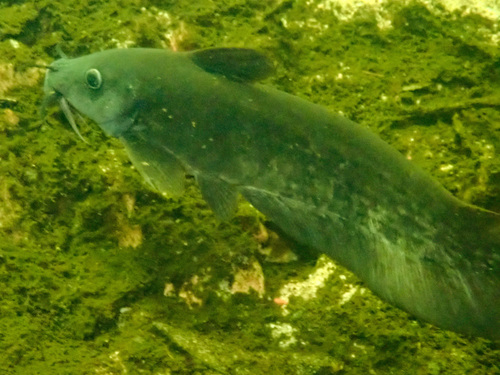
Black Catfish
Neosilurus ater
A sleek, nocturnal wanderer of Australia's tropical waterways, the Black Catfish is easily recognized by its eel-like tail and sensitive whiskers. This hardy survivor is a master of the midnight billabong, navigating the shadows with fluid grace.
Quick Identification
Size
Typically 30–40 cm (12–16 in), reaching a maximum length of 47 cm (19 in); weight generally ranges from 0.5–2 kg (1.1–4.4 lbs).
Colors
Uniform dark brown to charcoal or jet black on the upper body, fading to a pale grey or creamy white underbelly; fins are usually dark to match the body.
Key Features
- Eel-like tail where the second dorsal, caudal, and anal fins are fused into one continuous unit
- Four pairs of prominent sensory barbels around the mouth
- Sharp, mildly venomous spines at the front of the dorsal and pectoral fins
- Elongated, scaleless body with a narrow snout profile.
When You’ll See Them
Geographic range
Where Does the Black Catfish Live?
Native to the sun-drenched waterways of the southern hemisphere, the Black Catfish thrives across the tropical north of Australia and the southern regions of New Guinea. Its core habitat stretches from the rugged Kimberley in Western Australia, through the wetlands of the Northern Territory, and down the eastern coast of Queensland. These adaptable fish are commonly found in both coastal river systems and inland billabongs, making them a staple species of the Australasian freshwater landscape.
Basemap © OpenStreetMap contributors
Behavior
The Black Catfish is a primarily nocturnal inhabitant of freshwater systems, spending the daylight hours tucked away in dark recesses. They are masters of concealment, often found wedged under submerged logs, within rock crevices, or deep inside dense mats of aquatic vegetation. Unlike some of their more social relatives, adult Black Catfish are generally solitary, though juveniles may form loose schools for protection in high-flow areas.
When darkness falls, they become active foragers, using their highly sensitive barbels to navigate and locate prey in low-visibility water or silty substrates. Their swimming style is distinctive and fluid, utilizing an undulating, eel-like motion of the tail. While they are shy and tend to avoid human contact, they are a common sight for night-time snorkelers or those with underwater cameras in tropical billabongs. Caution is advised when handling them, as their dorsal and pectoral spines can deliver a painful sting.
EverydayEarth exclusive
Camera Tips
Capturing the Black Catfish requires a specialized underwater approach. Since standard trail cameras cannot be submerged, you will need an underwater housing or a dedicated waterproof action camera with an external power source for long-term monitoring. Position your camera on the river or pond bed, ideally near a 'snag' or submerged log where these fish naturally hide during the day. Angle the lens slightly upward to capture the unique silhouette and the movement of their barbels against the lighter surface water.
Because they are strictly nocturnal, lighting is your biggest hurdle. Avoid using bright white lights, which can cause 'backscatter' from suspended silt and may spook the fish. Instead, utilize infrared (IR) illuminators or very dim, diffused red LED lighting. For the best results, set your camera to record high-frame-rate video clips (at least 30 seconds long) rather than still photos. The undulating motion of their eel-like tail is a vital identification feature that is often lost in static images.
To draw a Black Catfish into the frame, use a scent-based lure. A perforated PVC pipe filled with oily fish scraps (like sardines or tuna) or crushed freshwater snails works exceptionally well. Secure the bait station about 30 to 50 cm in front of the lens. In backyard settings with ornamental ponds or creek access, the best footage is usually captured during the dry season when water clarity is at its highest, as the heavy silt of the wet season can make AI identification difficult.
Similar Species
Species that look similar or are commonly confused with Black Catfish.
Frequently Asked Questions
Record Black Catfish at your habitat
Connect a camera to start building your own species record — AI identifies every visitor automatically.