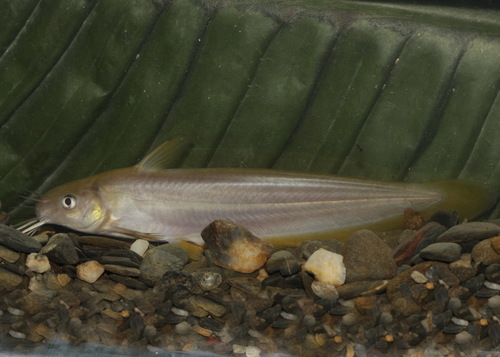
Hyrtl's Catfish
Neosilurus hyrtlii
A hardy survivor of the Australian outback, Hyrtl's Catfish is a fascinating, eel-like tandan that thrives in some of the country's most challenging freshwater environments.
Quick Identification
Size
Typically 15-28 cm (6-11 inches), though exceptional specimens can reach 40 cm (16 inches) and weigh up to 0.5 kg (1.1 lbs).
Colors
Varies from pale yellowish-brown to dark charcoal or deep black on the back, transitioning to a silvery or white belly; fins are usually yellowish or translucent.
Key Features
- Slender, eel-like body tapering toward the tail
- Four pairs of sensitive barbels around the mouth
- Short dorsal fin positioned forward on the body
- Continuous fin structure around the tail (tandan-style)
When You’ll See Them
Geographic range
Where Does the Hyrtl's Catfish Live?
Hyrtl's Catfish is a quintessential inhabitant of the Australian continent, native to the northern and central regions. Its core range spans from the Pilbara and Kimberley regions in Western Australia, across the Top End of the Northern Territory, and down through the Gulf of Carpentaria into southeastern Queensland and the Lake Eyre basin. It is one of Australia's most widely distributed freshwater fish, thriving in both tropical coastal streams and arid inland river systems.
Basemap © OpenStreetMap contributors
Behavior
Hyrtl's Catfish is a social, bottom-dwelling species known for its remarkable resilience and 'tandan' shape, which features a body that tapers into an eel-like tail. Often found in large schools, these fish spend much of their time vacuuming the substrate for food, using their sensitive whiskers (barbels) to detect prey in murky water where visibility is low. They are highly adaptable and are often the last species remaining in drying waterholes during the Australian dry season.
While generally shy, they exhibit fascinating group behavior, especially when moving through river systems during wet season floods. They are known to be quite active, frequently darting between submerged logs and aquatic plants. While they have little direct interaction with humans, they are a familiar sight to inland observers and play a crucial role in the freshwater ecosystems of northern Australia by controlling insect and crustacean populations.
EverydayEarth exclusive
Camera Tips
To capture Hyrtl's Catfish on camera, you will need a waterproof action camera or a specialized underwater housing for your trail cam. Because these fish are benthic (bottom-dwellers), place your camera on a weighted mount or a flat rock at the bottom of a shallow creek or billabong edge. Angle the lens slightly upward or keep it horizontal to the substrate to catch their whisker-flicking foraging behavior in the sand or silt.
Natural baiting is highly effective for this species. Place a small mesh bag filled with crushed pond snails, earthworms, or small bits of shrimp just inside the camera's field of view. The scent will draw the school in, and you’ll likely capture high-energy footage of multiple individuals competing for the food. Ensure the bait is secured to a heavy object so the catfish don't drag it out of the camera's frame.
While they are active during the day, their activity often peaks at dusk and during the night. Using a camera with high-quality infrared (IR) or 'no-glow' LEDs is essential for clear nighttime footage, as these catfish are not deterred by IR light. If the water is turbid or cloudy, place the camera very close to the bait—within 30 to 50 centimeters—to ensure the AI can clearly distinguish the whiskers and body shape of the fish.
During the Australian wet season (November to March), these fish become highly mobile as they move into flooded areas to spawn. If you have a backyard creek that flows only after rain, this is the prime time to set up your equipment. Look for eddies or slower-moving pockets of water behind submerged logs or rocks, as Hyrtl's Catfish will congregate there to rest and feed while navigating the current.
Similar Species
Species that look similar or are commonly confused with Hyrtl's Catfish.
Frequently Asked Questions
Record Hyrtl's Catfish at your habitat
Connect a camera to start building your own species record — AI identifies every visitor automatically.