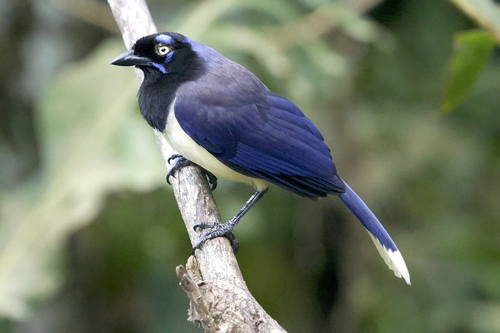
Black-chested Jay
Cyanocorax affinis
A striking and intelligent resident of the Neotropics, the Black-chested Jay is easily recognized by its piercing yellow eyes and bold black-and-white plumage. These social birds bring a burst of energy and a complex vocabulary to the forest edges of Panama and Colombia.
Quick Identification
Size
33–36 cm (13–14 in) in length; weighs approximately 195–210 g (6.9–7.4 oz)
Colors
Jet black head, chest, and mantle; deep violet-blue wings and tail; creamy white underparts; striking yellow eyes
Key Features
- Distinctive bright yellow irises
- Solid black 'bib' or chest patch
- White belly and undertail
- Vivid blue wings and tail with white tips
When You’ll See Them
Sightings on EverydayEarth
Jul 7, 2026
A Crimson-backed Tanager is perched on the feeder tray, busily pecking at a piece of orange. In the background, a Black-chested Jay is partially visible on a moss-covered log, observing the surroundings before moving out of view.
Apr 9, 2026
A Black-chested Jay is perched on the edge of a fruit feeder, where it spends several seconds feeding on orange slices and scanning its surroundings before hopping to another part of the tray.
Apr 9, 2026
A Gray-headed Chachalaca is seen exploring the mossy branch on the left, occasionally pecking at the vegetation. On the right side of the frame, a Black-chested Jay perches alertly, observing the surroundings. The feeding tray in the foreground is stocked with sliced oranges, though neither bird is feeding on them at this moment.
Apr 7, 2026
A Black-chested Jay is seen visiting the fruit feeder, actively eating from several halved oranges. After feeding for a few moments, it hops onto a moss-covered branch on the left, looks around briefly, and then flies out of the frame.
Apr 6, 2026
A Gray-headed Chachalaca perches on a mossy, orchid-covered branch before hopping down onto the feeding platform to eat sliced fruit. A Black-chested Jay briefly lands on the right side of the platform, stays for a moment, and then flies off.
Apr 3, 2026
Two Black-chested Jays are foraging on the fruit feeder platform. They hop between slices of orange and banana, pecking at the fruit while remaining alert to their surroundings in the lush tropical forest.
Geographic range
Where Does the Black-chested Jay Live?
Native to the Neotropics of Central and South America, the Black-chested Jay occupies a lush corridor stretching from south-central Costa Rica and Panama into the northern regions of Colombia and western Venezuela. This species is particularly common in the humid lowlands and foothills where forest meets more open terrain, making it a frequent sight for residents in these tropical zones. While it remains primarily a resident of its native range, its adaptability allows it to thrive in both pristine jungles and modified agricultural landscapes.
Basemap © OpenStreetMap contributors
Recorded on EverydayEarth
Behavior
The Black-chested Jay is a highly social and intelligent member of the crow family, typically found moving through the canopy in noisy family groups of 3 to 10 individuals. Like most corvids, they are exceptionally curious and bold, often being the first to investigate a new object or a potential predator in their territory. They communicate with a wide array of metallic clanging calls, whistles, and harsh scolding notes that can be heard from a significant distance.
In the wild, these birds are masters of opportunistic foraging. They are frequently seen following swarms of army ants to snatch up fleeing insects or moving through fruiting trees. While they can be wary of humans in deep forest settings, they often adapt well to rural gardens and shaded coffee plantations, where they may visit bird tables or investigate outdoor kitchens for easy scraps.
EverydayEarth exclusive
Camera Tips
To capture the stunning contrast of the Black-chested Jay's yellow eyes and black plumage, place your camera 5 to 7 feet high on a sturdy branch or trunk overlooking a clearing. Because these birds are social, one bird usually acts as a sentinel; if you see one on camera, keep the recording going, as several more are likely to follow shortly. Using a 'fast trigger' setting is essential, as their movements between branches are incredibly quick and jerky.
Baiting is highly effective for this species. A platform feeder stocked with halved bananas, papayas, or even a small amount of suet will act as a powerful magnet. If you are in a drier area or during the dry season, a solar-powered bubbling birdbath is an irresistible lure. Position the camera facing North or South to avoid the harsh tropical sun from blowing out the white feathers on their bellies.
For the best results, set your AI camera to 'Large Bird' detection and use a short video clip format (10–15 seconds) rather than still photos. This allows you to capture their fascinating social interactions and various vocalizations. Look for activity in the early morning hours just after sunrise, as this is when family groups are most active in their foraging circuits.
Similar Species
Species that look similar or are commonly confused with Black-chested Jay.
Frequently Asked Questions
Record Black-chested Jay at your habitat
Connect a camera to start building your own species record — AI identifies every visitor automatically.