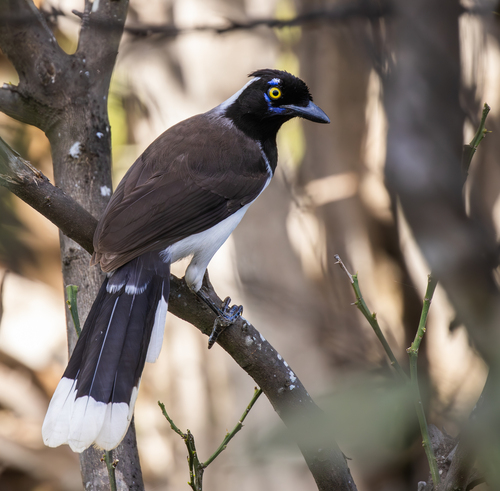
White-naped Jay
Cyanocorax cyanopogon
Meet the bold and intelligent sentinel of the Brazilian dry forests. With its striking white nape and sharp wit, the White-naped Jay is a master of the Caatinga landscape.
Quick Identification
Size
30-35 cm (11.8-13.8 inches) in length; weight approximately 110-160 grams (3.9-5.6 oz)
Colors
Jet black face, throat, and chest; brilliant white patch on the nape; violet-blue upperparts; creamy white belly and tail tips
Key Features
- Large white patch on the hindneck and nape
- Black mask extending to the upper breast
- Deep violet-blue wings and back
- Contrasting white underparts and tail edges
When You’ll See Them
Geographic range
Where Does the White-naped Jay Live?
The White-naped Jay is a South American treasure, found exclusively within the borders of Brazil. It is a signature species of the country's Northeast and Central regions, thriving across the vast landscapes of the Caatinga and the Cerrado. While it is most concentrated in states like Bahia, Ceará, and Minas Gerais, its adaptable nature allows it to occupy transitional forests and suburban wooded areas where native vegetation remains intact.
Basemap © OpenStreetMap contributors
Behavior
The White-naped Jay is a highly social and vocal member of the crow family, often found traveling in small, lively groups of 6 to 12 individuals. Known in Brazil as the 'Cancão,' they are the self-appointed sentinels of the forest, emitting loud, rhythmic calls that warn other wildlife of approaching predators or humans. Their intelligence is evident in their complex social structures and their ability to solve problems when searching for food.
These birds are remarkably bold and curious, frequently investigating new objects or activity within their territory. While they spend much of their time in the mid-to-upper canopy of dry forests, they are not shy about descending to the ground to forage or visit backyard feeding stations. Their interactions with humans are characterized by a mix of opportunistic scavenging and cautious observation from a distance.
EverydayEarth exclusive
Camera Tips
To capture the White-naped Jay on camera, focus your efforts on the 'transition zones' where dense scrub meets open clearings. These birds are highly social, so if you spot one on your feed, keep the camera rolling—the rest of the family group is likely trailing just seconds behind. Mounting your camera at a height of 5 to 7 feet on a sturdy tree trunk facing a known perching branch or a water source will yield the best results.
Because they are opportunistic foragers, you can attract them using a platform feeder stocked with native fruits like papaya or bananas, or even crushed maize. They are particularly drawn to water basins during the dry season; a shallow birdbath in a semi-shaded area is an irresistible draw for a group looking to bathe and drink. Position your camera to capture the basin from a slightly downward angle to see the brilliant white nape when they dip their heads.
For the best image quality, use a fast shutter speed or 'burst mode' on your AI camera. These jays are incredibly twitchy and move their heads with sudden, jerky motions. Setting your camera to be most active during the first three hours after sunrise will capture them at their most energetic. In the heat of the afternoon, look for them in shaded thickets where they retreat to escape the midday sun.
Similar Species
Species that look similar or are commonly confused with White-naped Jay.
Frequently Asked Questions
Record White-naped Jay at your habitat
Connect a camera to start building your own species record — AI identifies every visitor automatically.