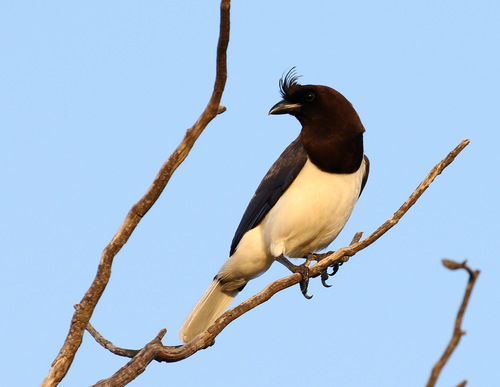
Curl-crested Jay
Cyanocorax cristatellus
With its unique pompadour-like crest and bold navy-and-white plumage, the Curl-crested Jay is the charismatic sentinel of the South American savanna. Intelligent and highly social, these 'blue crows' bring a splash of personality and noise to any backyard they visit.
Quick Identification
Size
Length of approximately 35 cm (14 inches); weight ranging from 170 to 210 g (6-7.4 oz)
Colors
Deep navy blue back and wings, velvety black head and breast, and a crisp white belly and tail tip. Sexes are monomorphic (look identical).
Key Features
- Distinctive forward-curling crest of stiff feathers on the forehead
- Velvety black 'hood' covering the head and upper chest
- Bright white underparts and tail terminal band
- Vibrant yellow iris that contrasts sharply with the black face
When You’ll See Them
Geographic range
Where Does the Curl-crested Jay Live?
The Curl-crested Jay is a quintessential inhabitant of the South American interior, primarily concentrated within the vast Cerrado biome. Its native range covers a massive portion of central and southeastern Brazil, stretching into the eastern plains of Bolivia and the northeastern reaches of Paraguay. Unlike some forest-dependent jays, this species thrives in more open, mosaic landscapes, allowing it to expand its presence into human-altered environments across the Brazilian Highlands.
Basemap © OpenStreetMap contributors
Behavior
Curl-crested Jays are highly social and intelligent birds, typically found in family groups of 6 to 12 individuals. These groups are cooperative, often working together to defend their territory or alert one another to predators with loud, rasping calls. They are known as the 'sentinels' of their habitat, as their alarm calls are often heeded by other wildlife species.
In their daily routine, they are bold and inquisitive. While they spend much of their time foraging in the mid-to-upper canopy, they are not shy about descending to the ground to investigate new objects or food sources. Their flight is heavy and direct, usually moving from tree to tree in a follow-the-leader fashion within their social group.
In suburban settings, they have adapted well to human presence. They are frequent visitors to gardens and parks where they can be quite opportunistic, sometimes stealing food from outdoor tables or learning the schedules of people who put out birdseed. Their complex social structure includes 'helpers' at the nest, where older offspring assist the breeding pair in raising new chicks.
EverydayEarth exclusive
Camera Tips
To capture the best footage of Curl-crested Jays, place your camera at a mid-level height, roughly 5 to 7 feet off the ground. While they do forage on the forest floor, they prefer landing on a horizontal branch or a fence post before descending. Mounting your camera on a tree trunk overlooking a flat stone or a low platform feeder will yield the most natural 'pose' shots as they stop to survey the area.
These jays are highly attracted to water, especially in the dry season of the Cerrado (May to September). A shallow, wide birdbath or a steady dripping water feature is an irresistible lure. Position your camera to face North or South to avoid the harsh tropical glare, and set it to 'burst mode' or short video clips, as these birds move in groups; once you see one, five more are likely to follow within seconds.
For baiting, Curl-crested Jays are particularly fond of whole corn, peanuts, and fatty fruits like papaya or avocado. If you are using a trail camera, placing these items on a textured log will keep the bird in the frame longer as it works to pick the food apart. Use a fast shutter speed or high-frame-rate video setting (at least 60fps) if your camera allows, as their crest-flicking and social interactions are very rapid.
Because they are intelligent, they will notice a new camera quickly. Don't be surprised if your first few videos are of a jay staring directly into the lens or even pecking at it. Using a camouflage housing or tucking the camera into natural foliage can help capture more candid social behaviors rather than just 'investigative' footage.
Similar Species
Species that look similar or are commonly confused with Curl-crested Jay.
Frequently Asked Questions
Record Curl-crested Jay at your habitat
Connect a camera to start building your own species record — AI identifies every visitor automatically.