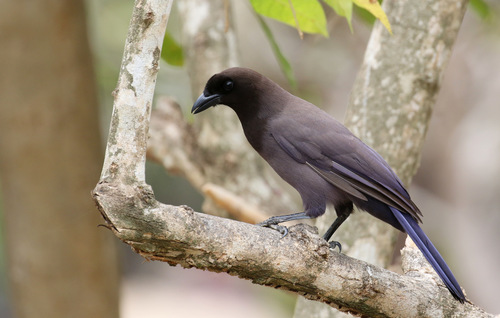
Purplish Jay
Cyanocorax cyanomelas
A social and vocal sentinel of the South American woodlands, the Purplish Jay captivates with its deep violet hues and remarkable intelligence. Often seen traveling in tight-knit family groups, this charismatic corvid is a master of adaptation in both wild forests and suburban edges.
Quick Identification
Size
Length: 36–37 cm (14–15 in); Weight: 185–210 g (6.5–7.4 oz)
Colors
Deep violet-blue to purplish-brown plumage; black face, throat, and upper breast; duller brownish-purple crown and nape; black bill and legs
Key Features
- Uniform deep purplish-blue body
- Blackish facial mask and throat
- Short, stiff feathers on the forehead forming a slight ridge
- Heavy, powerful black bill
- Long, rounded tail
When You’ll See Them
Geographic range
Where Does the Purplish Jay Live?
This striking bird is native to the central heartlands of South America. Its core population resides within the interior of Brazil, stretching across eastern Bolivia, Paraguay, and into northern Argentina. It is a familiar sight in the Pantanal and Chaco regions, and while it is mostly a resident species, it occasionally appears as a vagrant in Uruguay following river corridors.
Basemap © OpenStreetMap contributors
Behavior
The Purplish Jay is a highly social and intelligent member of the Corvidae family, typically seen moving through the mid-to-upper canopy in noisy groups of 6 to 12 individuals. These flocks are tightly knit, often engaging in sentinel behavior where one bird keeps watch while others forage. Their vocalizations are diverse and loud, consisting of various raucous 'chay-chay-chay' calls that serve to maintain group cohesion and warn of predators.
Inquisitive by nature, they are bold explorers of their environment. While they are primarily forest-dwelling birds, they have adapted remarkably well to human-altered landscapes. They are known to visit campsites, forest edges, and suburban gardens, where their curiosity often leads them to investigate new objects or potential food sources provided by humans. Like many jays, they are opportunistic and may cache food for later consumption.
During the breeding season, they exhibit cooperative tendencies, though less is documented about their specific nesting rituals compared to other Cyanocorax species. Their flight is characterized by steady wingbeats interspersed with short glides, usually moving from tree to tree rather than flying long distances across open ground.
EverydayEarth exclusive
Camera Tips
To capture the Purplish Jay on camera, placement is everything. These birds are canopy-dwellers that frequently descend to mid-levels or the ground for water and fallen fruit. Mount your camera 5 to 7 feet high on a sturdy trunk facing a clear flight path or a known water source. Using a wide-angle lens is beneficial because these jays almost always travel in groups; a narrow field of view might only capture one bird while the rest of the social interaction happens off-screen.
Luring Purplish Jays is relatively straightforward due to their opportunistic diet. Platform feeders stocked with native fruits like papaya, bananas, or even large seeds can attract a whole family group. They are also drawn to water; a raised birdbath or a dripping water feature in a wooded corner of your yard is an excellent focal point for your AI camera. Because they are curious, occasionally placing a 'novelty' object nearby—like a shiny bell or a textured wood block—can pique their interest and keep them in the camera's frame longer as they investigate.
Setting your camera to a 'burst' or 'multi-shot' mode is essential. Purplish Jays are active and somewhat twitchy in their movements. A single photo might result in a motion-blurred wing, but a 3-shot burst increases the likelihood of capturing that perfect, sharp profile of their violet plumage. Since they are most active in the early morning when light levels can be low under the forest canopy, ensure your camera has a high-quality sensor or set it to a slightly higher ISO to maintain a fast shutter speed.
Similar Species
Species that look similar or are commonly confused with Purplish Jay.
Plush-crested Jay
Easily distinguished by its bright yellow belly, white tail tips, and blue spots above and below the eyes.
Azure Jay
Found in more southern Atlantic forests; it has a more vibrant blue body that contrasts more sharply with its jet-black head.
Violaceous Jay
Very similar but found further north in the Amazon basin; it has a noticeably paler, almost whitish-grey nape and hindneck.
Frequently Asked Questions
Record Purplish Jay at your habitat
Connect a camera to start building your own species record — AI identifies every visitor automatically.