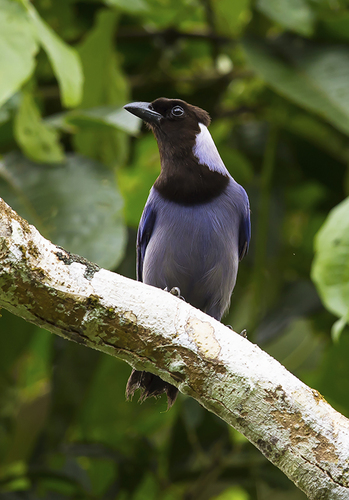
Violaceous Jay
Cyanocorax violaceus
A social and intelligent jewel of the Amazon, the Violaceous Jay stands out with its stunning violet plumage and bold personality. These clever corvids are the lively, vocal sentinels of the South American forest edge.
Quick Identification
Size
33–38 cm (13–15 in) in length; weighs approximately 215–262 g (7.6–9.2 oz)
Colors
Dull violet-blue body and wings; jet-black face, throat, and upper breast; distinct pale blue to white nape and hindneck
Key Features
- Striking black facial mask and bib
- Contrasting pale white or sky-blue nape
- Deep violet-blue plumage on back and wings
- Strong, thick black bill
When You’ll See Them
Geographic range
Where Does the Violaceous Jay Live?
The Violaceous Jay is a quintessential resident of South America, primarily inhabiting the vast Amazon Basin and the surrounding tropical lowlands. Its native range spans across Brazil, Colombia, Venezuela, Peru, and Ecuador, reaching as far south as northern Bolivia. While they are most abundant in the heart of the rainforest, they are frequently spotted along the edges of the Guiana Shield and are considered a staple species of the Orinoco river system. They do not migrate, remaining in their tropical territories throughout the year.
Basemap © OpenStreetMap contributors
Behavior
Violaceous Jays are highly social and intelligent birds, typically found moving through the canopy in noisy family groups of two to twelve individuals. Like many members of the corvid family, they are extremely vocal, using a wide array of harsh, ringing calls to maintain group cohesion and sound the alarm when predators like hawks or snakes are nearby. They are inquisitive by nature and will often investigate new objects or activity within their territory.
In the wild, they exhibit complex social structures and are known for their cooperative nature. While they can be wary of humans in remote areas, those living near forest edges or agricultural clearings can become quite bold. They are active foragers, spending their day hopping through branches or occasionally descending to the forest floor to investigate leaf litter for food. Their flight is typically direct with steady wingbeats, often moving one by one across openings in the forest.
EverydayEarth exclusive
Camera Tips
To capture the best footage of the Violaceous Jay, position your camera near the 'edge' zones of your property—places where dense brush meets open lawn or clearings. These birds are canopy-dwellers but frequently descend to lower heights when foraging or moving between cover. Setting your camera at a height of 5 to 7 feet, tilted slightly downward, will capture them as they hop between lower branches. Use a fast trigger speed, as their movements are quick and jerky.
Water is your best ally for attracting these jays. They are fond of bathing and drinking, especially during the hotter parts of the afternoon. A elevated birdbath or a natural water feature will often draw the whole family group in at once, providing excellent multi-subject shots. Because they travel in groups, a wide-angle lens setting is preferable to ensure you catch the social interactions between individuals.
If you are looking to bait a specific spot, fatty treats or local fruits are highly effective. Suet-style feeders or open platforms with native fruits like figs or palm nuts will keep them lingering in front of the lens. Early morning light is crucial for bringing out the violet hues of their feathers; in deep shade, they can often look dull or black. Aim your camera toward a spot that receives dappled sunlight to capture the true iridescence of their plumage.
Lastly, consider the audio capabilities of your camera. Violaceous Jays are famous for their loud, characterful vocalizations. High-quality video with sound will allow you to record their 'jeer-jeer' calls, which are a hallmark of the Amazonian soundscape. Ensure your camera is protected from tropical humidity with a dedicated housing or rain shield if you are in their native humid range.
Similar Species
Species that look similar or are commonly confused with Violaceous Jay.
Purplish Jay
Lacks the Violaceous Jay's distinct pale/white nape and is generally darker and more uniform in color.
Azure Jay
Found much further south in Brazil; it is larger with more intense blue plumage and lacks the pale nape patch.
Azure-naped Jay
Has a much more prominent, brighter blue crown and nape, and its range is more restricted to the upper Rio Negro region.
Frequently Asked Questions
Record Violaceous Jay at your habitat
Connect a camera to start building your own species record — AI identifies every visitor automatically.