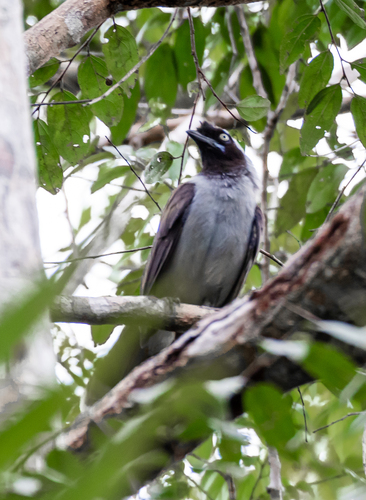
Azure-naped Jay
Cyanocorax heilprini
A social and striking inhabitant of the Amazon's white-sand forests, the Azure-naped Jay stands out with its brilliant blue crown and bold personality.
Quick Identification
Size
33–36 cm (13–14 inches) in length; weight typically ranges from 165–195 grams (5.8–6.9 oz)
Colors
Soft grayish-brown upperparts with a luminous azure-blue patch on the nape and crown; black face, throat, and upper breast; white belly and undertail; blue tail with prominent white tips
Key Features
- Vibrant azure-blue patch on the back of the head and neck
- Thick black 'bib' covering the entire face and throat
- White-tipped tail feathers visible in flight
- Pale, creamy-white to yellowish iris
- Sturdy, black corvid beak
When You’ll See Them
Geographic range
Where Does the Azure-naped Jay Live?
The Azure-naped Jay is native to the northern reaches of South America, occupying a relatively specialized ecological niche. Its core range is centered around the upper Rio Negro basin, where the borders of northwestern Brazil, southern Venezuela, and eastern Colombia meet. Within this region, it is strictly tied to specific soil types and forest structures, making it a localized find for birdwatchers and researchers.
Basemap © OpenStreetMap contributors
Behavior
The Azure-naped Jay is a highly social and vocal member of the crow family, typically moving through the understory and mid-canopy in noisy family groups of four to ten individuals. Like many corvids, they are remarkably intelligent and curious, often investigating new objects or sounds within their territory. They communicate with a wide array of metallic clicks, whistles, and harsh alarm calls that can be heard from a significant distance.
These jays are active foragers that demonstrate complex social structures, including cooperative breeding where older offspring may help raise the new brood. While they can be wary of humans in remote areas, their natural curiosity often brings them to the edges of clearings or trails. They spend much of their day hopping through branches or dropping to the sandy forest floor to investigate potential food sources.
EverydayEarth exclusive
Camera Tips
To capture the Azure-naped Jay on an AI-powered camera, placement is everything. These birds are specialists of 'campinarana' habitats—areas with sandy soil and shorter, thinner trees. Look for natural clearings or the edges of these scrubby forests. Mounting your camera at chest height (3–5 feet) angled slightly upward towards a perching branch or downward toward a clear patch of sand will yield the best results, as they often descend to the ground to forage.
Because they are social birds, if you see one on your feed, there are likely several more nearby. Using a camera with a fast trigger speed or a 'burst' mode is essential to catch the movement of the entire family group. If legal and ethical in your area, a small offering of native fruits or even a shallow water basin (bird bath) can be an irresistible lure, as these jays are frequent bathers and enjoy water sources in their often-arid sandy habitats.
Early morning is the 'golden window' for this species. Set your camera's sensitivity to high during the first three hours after sunrise. Since they have bright white bellies and dark heads, try to place the camera in a spot with filtered light rather than direct, harsh sunlight to avoid overexposing the white plumage while losing detail in the black facial mask. Using a wide-angle lens setting is preferable to capture the group dynamics that make this species so fascinating.
Similar Species
Species that look similar or are commonly confused with Azure-naped Jay.
Frequently Asked Questions
Record Azure-naped Jay at your habitat
Connect a camera to start building your own species record — AI identifies every visitor automatically.