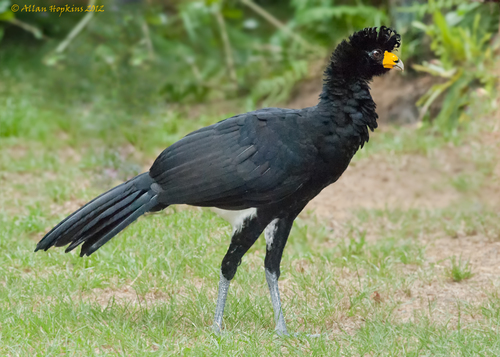
Black Curassow
Crax alector
Meet the 'lord of the forest floor,' a majestic bird with a curly crown and a deep, booming voice. Found in the lush jungles of the Guiana Shield, the Black Curassow is a true icon of South American wildlife.
Quick Identification
Size
Length 33–37 inches (85–95 cm); weight 6.6–8.8 lbs (3–4 kg)
Colors
Lustrous blue-black plumage throughout; white feathers on the under-tail area (crissum); bright yellow or orange-red base of the bill (cere).
Key Features
- Curled crest of black feathers on the head
- Bright yellow or orange-red fleshy cere at the base of the beak
- Distinctive white vent contrasting with jet-black body
- Large, turkey-like silhouette with long legs
When You’ll See Them
Geographic range
Where Does the Black Curassow Live?
Native to the northern regions of South America, the Black Curassow is primarily found in the pristine rainforests of the Guiana Shield. Its core range spans across French Guiana, Guyana, Suriname, southern Venezuela, and northern Brazil, particularly north of the Amazon River. Though naturally restricted to these tropical mainland habitats, populations have also been introduced to various Caribbean islands including Puerto Rico and the Bahamas.
Basemap © OpenStreetMap contributors
Behavior
The Black Curassow is a regal, ground-dwelling bird that spends much of its day patrolling the forest floor in search of fallen fruit. While they are primarily terrestrial, they are excellent climbers and will take to the trees to roost at night or when threatened. They are often found in pairs or small family groups, communicating with low-frequency booming calls that can travel long distances through dense vegetation.
In areas where they are not hunted, these birds can become somewhat bold, though they generally remain cautious of human presence. Their social structure is stable, and they are known to be monogamous. During the breeding season, males perform displays involving wing-clapping and booming to maintain territory and attract mates.
EverydayEarth exclusive
Camera Tips
To capture the elusive Black Curassow, place your camera along established forest trails or near the base of large, fruiting trees like figs or palms. These birds are heavy and strictly terrestrial when foraging, so mount your camera low—about 12 to 18 inches off the ground—to get a clear profile shot. Angle the lens slightly upward to capture the detail of their iconic curly crest and vibrant bill cere.
Because they are sensitive to movement, ensure your camera is well-camouflaged and use a model with a fast trigger speed; they often move at a steady walking pace and can easily blur if the shutter is slow. While we don't recommend artificial baiting in wild forest settings, setting up near a natural water source during the dry season can yield spectacular results as they visit daily to drink.
Lighting in dense rainforest can be tricky, so use a camera with high-quality IR flash for early morning or late afternoon shots. The Black Curassow is most active during the first few hours of daylight. If your camera has a video mode, try a 15-second clip to capture their unique 'booming' vocalizations and the characteristic way they flick their tails while walking.
Similar Species
Species that look similar or are commonly confused with Black Curassow.
Frequently Asked Questions
Record Black Curassow at your habitat
Connect a camera to start building your own species record — AI identifies every visitor automatically.